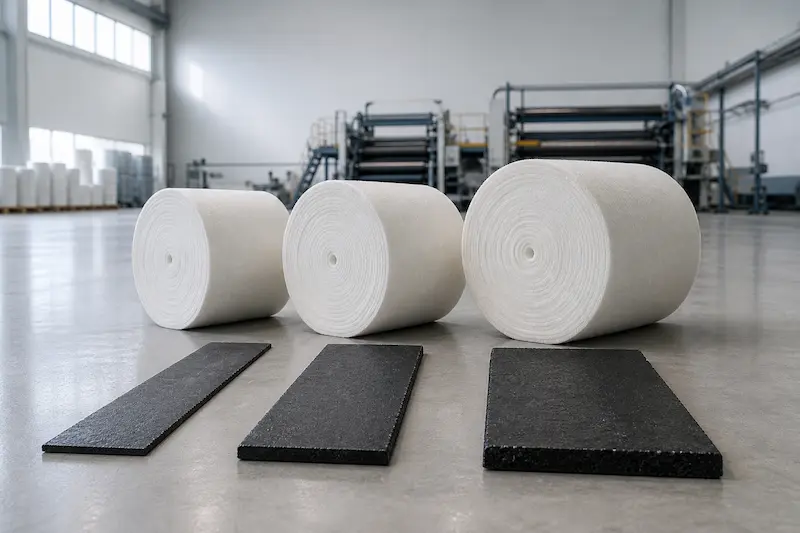
Choosing the right polyester mat weight starts with one question that most spec sheets leave open: what does the carrier actually have to do at this thickness? On most SBS and APP lines, 3 mm sheets run on 140–180 g/m² spunbond or 120–140 g/m² reinforced fabric, 4 mm sheets run on 180–200 g/m² spunbond or 140–180 g/m² reinforced fabric, and 5 mm sheets run on 200–260 g/m² spunbond or 180–260 g/m² reinforced fabric. However, those bands describe common practice rather than a fixed rule, because construction and line conditions can move the answer by two grades in either direction. Therefore, treat the bands as a starting point and confirm them against three checks: mass balance, tensile demand, and cost share.
Why Thickness Alone Cannot Set the Polyester Mat Weight
Membrane thickness fixes the volume of bitumen in the sheet. It says almost nothing about the tensile backbone, and the backbone is the carrier’s main job. Consequently, two producers can run the same 4 mm profile on very different fabrics and each still meets its own product standard, because reinforcement construction changes how much tensile strength a given weight delivers.
Three variables move as thickness increases:
- The mass hanging on the web. A thicker coating adds weight to every metre of fabric that the line pulls through saturation, cooling and winding. In addition, the same web must resist width loss while the coating shrinks on cooling.
- The performance class of the sheet. Producers rarely sell 5 mm sheets into the same segment as 3 mm sheets, and the higher class usually carries a higher tensile requirement.
- The surface finish. Mineral surfacing and heavy films add mass and stiffness that the carrier has to support.
Meanwhile, thickness on its own leaves the reinforcement question unanswered.
The Mass Balance: What a Heavier Carrier Really Adds
Run the arithmetic once, and the trade-off becomes obvious. The areal mass of a finished membrane is the sum of three layers:
Membrane (g/m²) ≈ carrier (g/m²) + bitumen compound (g/m²) + surface finish (g/m²)
For example, a 4 mm sheet at a compound density near 1.0–1.1 g/cm³ carries roughly 4.0–4.4 kg/m² of bitumen compound across its nominal thickness. Now compare two carriers: moving from 140 g/m² to 200 g/m² adds 60 g/m², which equals about 1.4% of a 4.3 kg/m² sheet. As a result, the weight itself rarely decides the choice. Instead, three factors decide it — tensile strength, dimensional stability at coating temperature, and cost per square metre of good membrane.
The 3 mm Membrane: Light Coating, Light Carrier
A 3 mm SBS or APP sheet carries the thinnest coating of the three, so it loads the web least and tolerates the lightest reinforcement. Typical practice looks like this:
- Standard spunbond: 140–180 g/m²
- Reinforced spunbond: 120–140 g/m²
Our 140 g/m² reinforced spunbond polyester mat reaches ≥260/230 N/5 cm with ≥15% elongation, and the 120 g reinforced grade reaches ≥220/200 N/5 cm. Both suit 3 mm sheets built for residential roofing, repair membranes and price-led programmes. For a polyester mat for 3 mm membrane specification, in short, the reinforced route buys tensile at a lower base mat gram weight. In contrast, a 3 mm sheet bound for a cold climate or a movement-prone deck needs more elongation, and the standard 140 g/m² spunbond polyester mat delivers ≥230/200 N/5 cm with ≥18% elongation for exactly that reason.
The 4 mm Membrane: Where Most Volume Sits
Four millimetres is the volume standard in most markets, and it is the thickness where the choice between weight and construction matters most. Typical practice:
- Standard spunbond: 180–200 g/m²
- Reinforced spunbond: 140–180 g/m²
- Compound base mat with fiberglass mesh: 150–200 g/m²
The 4×4 compound base mat combines a 4×4 fiberglass leno scrim with polyester nonwoven and reaches tensile ≥450/400 N/5 cm at 150–200 g/m², with heat resistance of ≥150 °C. That value is where the grid earns its place, because a scrim-based construction reaches tensile levels that a plain spunbond mat of the same weight cannot approach. For the polyester mat for 4 mm membrane specification, consequently, the real decision is rarely “how heavy” — it is “which construction.” Treat 180 g/m² as the working polyester mat weight for mainstream 4 mm production, and move one grade up or down from that position.
The 5 mm Membrane: Heavy Duty and Inverted Roofs
At 5 mm the coating mass reaches its highest level, and the web carries the most weight through the cooling section. Typical practice:
- Standard spunbond: 200–260 g/m²
- Reinforced spunbond: 180–260 g/m²
- Compound base mat: Leno 99 at 180 g/m²
Consequently, dimensional stability matters more here than at 3 mm, and heat shrinkage becomes the specification that decides whether the sheet holds its width. A polyester mat for 5 mm membrane therefore leans on reinforced or scrim-based construction rather than on added weight alone. If you want to read that mechanism in detail, heat shrinkage at saturation temperature explains what the hot bitumen bath does to different fabric structures.
Carrier-to-Thickness Selection Matrix
| Membrane thickness | Typical application | Standard spunbond | Reinforced spunbond | Compound base mat | Tensile floor (MD/CD, N/5 cm) |
|---|---|---|---|---|---|
| 3 mm | Residential roofing, repair sheets, price-led ranges | 140–180 g/m² | 120–140 g/m² | Not typical | ≥ 220 / 200 |
| 4 mm | Mainstream roofing and below-grade waterproofing | 180–200 g/m² | 140–180 g/m² | 4×4, 150–200 g/m² | ≥ 260 / 230 |
| 5 mm | Heavy-duty, inverted roofs, infrastructure | 200–260 g/m² | 180–260 g/m² | Leno 99, 180 g/m² | ≥ 300 / 270 |
These ranges reflect common practice and our own published grade data. Nevertheless, they are typical values — always confirm them against your own product standard, coating formulation and line speed before you place an order.
When to Spec One Step Heavier
Four conditions justify stepping up one grade:
- High line speed. Faster lines raise web tension, and a heavier mat resists stretching better.
- Cold-climate service. Low-temperature flexibility depends on elongation, which generally rises with weight in standard grades.
- Mineral-surfaced cap sheets. Foot traffic and granule weight punish a light carrier.
- Inverted roofs and paver decks. These systems load the membrane in ways that reward puncture resistance.
Moreover, humid storage softens rolls over time, so plan your stock rotation; moisture uptake in storage explains why.
When a Lighter Mat Wins
Two situations favour the lighter option:
- Reinforced construction beats weight. A reinforced spunbond polyester mat reaches higher tensile at a lower gram weight than a standard grade, so a 140 g reinforced fabric can outperform a 200 g standard fabric in tensile terms. We compare the two families in spunbond vs reinforced spunbond.
- Elongation governs the application. Where the deck moves and flexibility matters more than raw strength, a standard spunbond mat at the same weight offers higher elongation. By contrast, a stiffer fabric fails earlier under repeated movement.
In practice, cost closes the loop. A heavier mat consumes more bitumen during saturation, and that consumption shows up in your tonnage figures rather than your fabric invoice — a mechanism we quantify in oil absorption vs cost.
How to Verify the Number Before You Commit
Never accept a nominal polyester mat weight on a quotation alone. Ask for these five items in writing, then test them on receipt:
- Measured GSM range, not nominal — for example 180 ± 5 g/m², with a certificate per roll.
- Tensile strength in both MD and CD in N/5 cm, together with the MD/CD ratio.
- Elongation at break, because tensile without elongation tells you half the story.
- Heat shrinkage at your coating temperature, since 160–200 °C is where width disappears.
- Physical samples, including a roll face you can inspect for splice quality.
Our guide to how to test polyester mat quality before you buy walks through all five checks in sequence, and how to spec a polyester mat explains how the test methods behind them work. Independent copies of those methods come from the ASTM D5147 standard for sampling and testing modified bituminous sheet materials and EDANA’s introduction to nonwovens. Roof-system guidance comes from the National Roofing Contractors Association and the Asphalt Roofing Manufacturers Association; sheet specifications from ASTM D6164 and EN 13707.
FAQ
Does a thicker membrane always need a heavier polyester mat?
No. Thickness sets the bitumen volume, and the carrier provides tensile strength and dimensional stability. Therefore, a 5 mm sheet can run on a 180 g/m² reinforced fabric when that fabric meets the tensile and shrinkage targets, while a 3 mm sheet in a demanding application may need 180 g/m² standard grade for elongation. Match the fabric to the performance class, not to the millimetre figure.
Can a 120 g/m² mat carry a 4 mm membrane?
Only where the application is undemanding. A 120 g/m² reinforced mat delivers ≥220/200 N/5 cm, which satisfies light-duty and repair products but leaves little reserve for a 4 mm coating pulled at speed. For the 4 mm mainstream we recommend 140 g/m² reinforced or heavier.
What tensile strength should I specify for a 4 mm membrane?
Treat ≥260/230 N/5 cm as a practical floor for standard 4 mm production, then confirm it against your own product standard. Compound base constructions with a 4×4 scrim reach ≥450/400 N/5 cm at 150–200 g/m², and those values give you headroom for infrastructure work.
Should I choose reinforced or standard spunbond at 5 mm?
Let the application decide. Standard spunbond at 200–260 g/m² suits sheet systems that need flexibility, while reinforced grades at 180–260 g/m² suit heavier loading and better dimensional stability. However, verify heat shrinkage on both, because a 5 mm coating amplifies any width instability.
How much does the carrier add to total membrane weight?
Roughly 3–6% of the finished sheet. Therefore, a heavier carrier changes your material cost far more than it changes your product weight, which is why the decision belongs in a cost-per-square-metre calculation rather than a weight comparison.
Does a heavier mat absorb more bitumen?
Yes, and the effect is measurable. A denser structure holds more compound during saturation, so a heavier or thicker mat raises your bitumen consumption per square metre of membrane. Quantify that change before you switch grades, because it can offset the fabric saving.
Conclusion
Carrier selection at 3 mm, 4 mm and 5 mm comes down to three checks rather than one figure: the mass balance, the tensile and shrinkage demand of the performance class, and the cost per square metre of good membrane. Use the matrix above as your opening position, then adjust it for line speed, climate and surface finish. Finally, always confirm the measured polyester mat weight and the supporting values on a certificate before you commit to a container.
For samples, grade data and a specification review against your own line, contact the Guanlong Waterproof team or browse the full polyester mat range.