A delivery passes incoming inspection on a Tuesday. Nine weeks later, the same rolls behave differently: the web feels softer, the roll face steps, and the saturation line leaves voids that never appeared in the trial run. Nobody changed a specification. Something changed the fabric while it sat on a pallet.
Moisture explains most of that drift. Polyester resists water far better than cotton, yet a nonwoven mat is mostly air, and airspace gives water somewhere to go. This article explains how uptake happens, what it changes on your line, how to measure it, and how to store rolls so the material you bought still matches the material you run.
Why a polyester mat takes up moisture at all
Start with the fibre. Polyester belongs to the family of fibres that hold little water, because its polymer chains offer few places for water molecules to attach. That property underpins the shift from cotton carriers to polyester carriers across membrane production.
Now consider the structure. A spunbond or needle-punched mat contains a small fraction of fibre by volume, and the rest is void space between and inside the filaments. That structure creates two routes for water:
- Surface adsorption. Water molecules attach to the fibre surface, and a fine fibre creates far more surface per gram than a coarse one.
- Capillary condensation. In the smallest pores, water condenses at relative humidity well below the level that would wet a flat surface.
Add residual moisture from production and any surface finish left on the web, and a mat becomes a moderately hygroscopic structure even though the base polymer is not.
Consequently, storage conditions act on the fabric continuously. Humidity rises, the mat gains mass. Humidity falls, the mat releases part of that mass. Meanwhile, the internal structure does not always return to its starting state.
What actually changes after weeks in storage
The changes arrive as a pattern rather than as one obvious fault. Watch for this set.
| Change | Where you notice it | Why it matters |
|---|---|---|
| Mass gain against declared weight | Goods-in weighing | You paid for carrier and received water |
| Softer web, relaxed winding | Operator feel at the unwinder | Tension settings no longer match the roll |
| Cockled or wavy edges | Roll face and web edges | Web wander and trim problems follow |
| Steps and bulges in the roll face | Visual check before loading | Uneven feed and thickness variation |
| Voids and bubbles after saturation | Saturation bath and cooling section | Adhesion faults in the finished sheet |
| Uneven bitumen pick-up | Sheet weight and thickness checks | Off-spec product and scrap |
| Staining, odour, or mildew | Inspection under the wrap | Rejection risk in humid climates |
| Condensation inside the wrap | Wrap opened in a warm room | Local wet patches and adhesion faults |
This review of common polyester mat defects links several of these symptoms back to their causes in the fabric and in the process.
Five conditions that drive moisture uptake
Moisture uptake responds to five variables, and you control all five.
1. Relative humidity and temperature. Warm air carries more water, so absolute humidity matters more than the percentage on a gauge. A store at high humidity and high temperature moves water into the mat fastest.
2. Temperature cycling. This variable causes the worst damage. Air at night cools, water condenses on cold surfaces, and the mat meets liquid water rather than vapour. Repeat the cycle for a few weeks and the mat at the bottom of the stack suffers most.
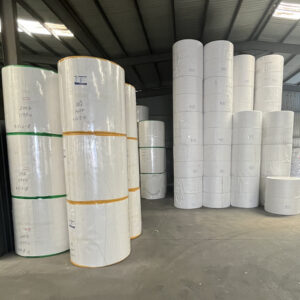
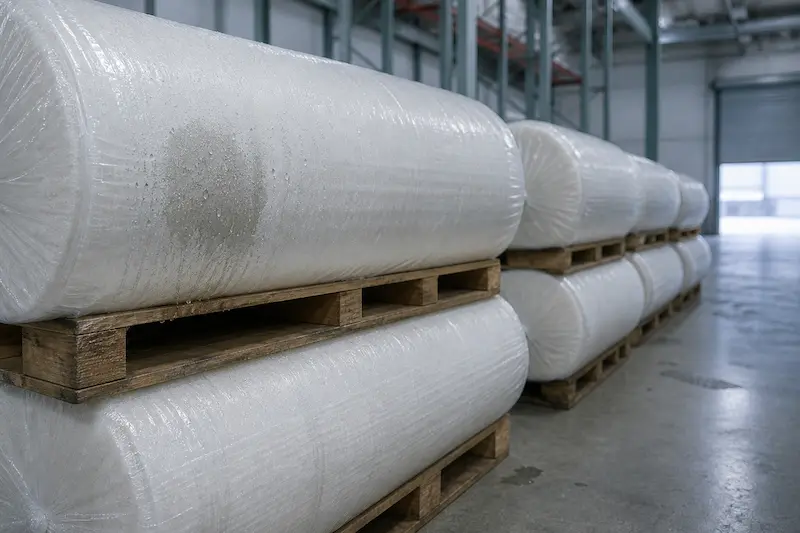
3. Packaging. A sealed PE wrap with a desiccant limits vapour exchange. An open roll on a wooden pallet in a humid shed exchanges vapour continuously, and timber adds its own moisture.
4. Storage time. Uptake follows a curve that flattens as the mat approaches equilibrium with its surroundings. In practice, the first weeks bring the largest change, which explains why problems appear after a few weeks rather than on day one.
5. Contact and air movement. Rolls stored against a cold concrete floor or an external wall pick up condensation first. Meanwhile, a poorly ventilated corner traps humid air and keeps it there.
How to measure uptake and set a limit
You cannot manage a variable you never measure. Three steps give you control.
Step 1 — record the moisture at dispatch. Ask your supplier for a moisture figure per batch, measured by a defined method. Our own control process from raw fibre to finished roll shows where that figure sits in production.
Step 2 — record the mass at arrival and after storage. Weigh a reference roll at goods-in, then again after four and eight weeks in your store. The difference tells you what your warehouse does to your material.
Step 3 — condition samples before you weigh them. This step carries more weight than most buyers realise. ASTM D1776/D1776M, the standard practice for conditioning and testing textiles, states that prior exposure to high or low humidity affects the equilibrium moisture pick-up, and it therefore defines a preconditioning procedure alongside the standard testing atmosphere. Weigh a sample straight out of a cold container or a dry store, and you measure its history rather than its moisture.
Nonwoven producers also work from harmonised procedures that cover conditioning and physical testing of nonwoven structures. EDANA publishes the Nonwovens Standard Procedures jointly with INDA, and those methods give you a defensible way to describe moisture and mass properties in a purchase agreement.
What a small percentage actually costs
The arithmetic below uses illustrative inputs so you can follow the method. Insert your own roll weight and annual volume.
Assume a 500 kg roll and a 1% mass gain in storage.
- Water per roll: 500 kg × 1% = 5 kg
- Across 1,000 rolls a year: 5,000 kg — five tonnes of water
Five tonnes of water costs you nothing at the tap. As carrier material, however, it travels through your purchase order at carrier prices, occupies warehouse space, and complicates every weight reconciliation. Now compare a delivery at 0.5% moisture with one at 2%: the difference reaches 7.5 kg on each 500 kg roll, and the effect compounds across a season of receiving.
Storage rules by climate zone
One storage procedure cannot serve every plant. Adapt the rules below to the conditions your warehouse actually faces.
| Climate | Main risk | Practical rules |
|---|---|---|
| Temperate | Seasonal humidity swings | Keep rolls off the floor on pallets, ventilate the store, use the oldest stock first |
| Hot and humid | Continuous vapour uptake, mildew | Dehumidify or air-condition the store, keep wraps sealed until use, cap storage time |
| Cold | Condensation when rolls enter a warm plant | Let sealed rolls equalise before opening, then open and run promptly |
| Arid | Heat-driven drying and brittleness | Protect the wrap, and condition samples before testing |
| Coastal | Salt-laden humid air | Seal packaging, inspect wraps for corrosion of cores and straps |
Two rules apply everywhere. First, keep stock moving on a first-in, first-out basis, because time in store drives the change. Second, never store rolls in direct contact with a cold external wall or floor.
Container transit: the part buyers forget
Your warehouse may behave well, and the container may still deliver wet material. Temperature cycling during a sea voyage causes the effect the industry calls container rain or cargo sweat: humid air condenses on the inner surfaces of the container as the outside temperature drops overnight, and the droplets fall onto the cargo.
The effect intensifies when cargo contains its own moisture, when the stow sits against the container walls, and when the voyage crosses several climate zones. TT Club publishes loss prevention guidance on cargo and warehouse risks, and its materials cover the kinds of transit exposures that produce moisture claims.
Practical mitigation follows a simple logic: reduce the water you load, manage the air around the cargo, and avoid thermal contact.
- Reduce the water you load. Use desiccant bags sized for the container volume and the voyage length, and never load damp pallets.
- Manage the air around the cargo. Wrap pallets fully, and confirm that wraps stay intact at the corners.
- Avoid thermal contact. Keep cargo clear of container walls, and use dunnage where the stow could shift.
- Fix responsibility in writing. Include a moisture clause in the purchase agreement, so accountability is clear before the container sails.
- Plan for delays. Port storage and transshipment extend the exposure, so add time to the estimate for humid routes.
A fifteen-minute moisture check at goods-in
You need a scale, a knife, and a moisture meter or an oven. Run the check below on every delivery, and record the result against the batch number.
| Check | Method | Warning sign |
|---|---|---|
| Roll weight | Weigh one roll and compare with the declared weight | Consistent overweight across the delivery |
| Wrap integrity | Inspect all faces, especially the lower third | Tears, wet patches, or condensation inside the film |
| Core and straps | Look for corrosion or swelling | Rust staining or a deformed core |
| Web feel | Open a roll and handle the outer layers | A soft, limp web compared with your reference roll |
| Edge condition | Sight along the roll face | Cockled edges or visible steps |
| Surface appearance | Check for staining or odour | Discolouration or a musty smell |
| Moisture reading | Use a meter, or oven-dry a sample and compare mass | A reading above your specification limit |
This quality test guide for polyester mat extends the list to strength, gram weight, and absorption, and it pairs well with the inspection steps above. Meanwhile, the full specification guide shows how to write each limit into a purchase order.
Where the finished membrane meets vapour, remember that the whole assembly matters: vapour barrier fabrics play a larger role in building envelope performance than their price suggests. In addition, moisture carried into a membrane shows up later as reduced service life, which is one reason carrier fabric quality shapes lifespan more than the bitumen does. The ARMA technical bulletins on modified bitumen roofing cover related material issues, including how contaminants and residue affect sheet performance.
FAQ
Why does polyester mat gain moisture if polyester repels water? The polymer itself holds little water, yet a nonwoven mat is mostly void space. Fine fibres present a large surface area for adsorption, and the smallest pores condense water at moderate humidity. Consequently the structure gains moisture even though the base fibre resists it.
What moisture content should carrier fabric have at delivery? Set the limit from your own weighing and running experience, then state both the limit and the test method in the purchase agreement. A defined method matters as much as the number, because conditioning history changes the result.
How long can I store polyester mat rolls? Time in store drives the change, so apply first-in, first-out and keep storage as short as your planning allows. In hot and humid climates, cap storage and re-check a reference roll after four and eight weeks.
What is container rain and does it damage carrier fabric? Container rain describes condensation that forms on the inner surfaces of a shipping container and drips onto the cargo. It deposits liquid water on the upper rolls, which can produce local wet patches, staining, and adhesion faults in the finished membrane.
Should I unpack rolls as soon as they arrive? Not always. A cold roll moved into a warm, humid plant attracts condensation on its surface. Let a sealed roll equalise to plant temperature first, then open it and run it promptly.
How do I weigh a sample correctly? Condition the sample to a stable mass in a controlled atmosphere before weighing, because ASTM D1776/D1776M notes that prior exposure to high or low humidity affects equilibrium moisture pick-up. Weighing an unconditioned sample measures where the roll has been, not how much water it holds.
Next step
Pick one reference roll from your next delivery. Weigh it at goods-in, store it as usual, and weigh it again after four and eight weeks. Those three numbers reveal what your warehouse does to your material, and they give you a factual basis for a moisture clause in your next purchase order.
Guanlong Waterproof supplies spunbond and reinforced polyester mat to membrane producers worldwide, including tropical and coastal markets where moisture control decides whether a roll performs. Send us your port of discharge and storage conditions, and we will propose a packaging and moisture specification that fits the journey.