Choosing a polyester mat for your waterproofing membrane line is one of the most consequential purchasing decisions you will make as a membrane manufacturer. The carrier fabric hidden inside the sheet quietly decides how your roll behaves during coating, how it survives transport, and how long it performs on the roof. As we explained in Why Carrier Fabric Quality Determines Membrane Lifespan, the bitumen gets most of the credit — but the base mat does most of the work.
However, most buyers still spec a polyester mat by price alone. Therefore, this guide walks through the three numbers that actually matter — GSM, tensile strength and elongation — and shows you how to read them like a production engineer. In addition, we will cover a few secondary parameters that quietly cause defects downstream.
What Is a Polyester Mat?
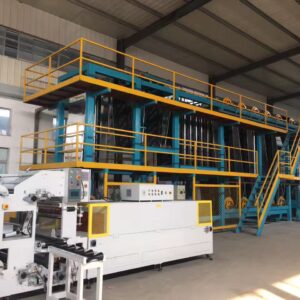
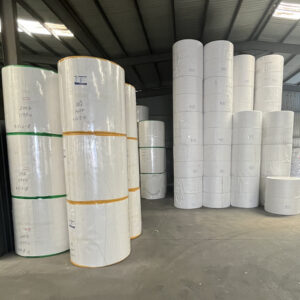
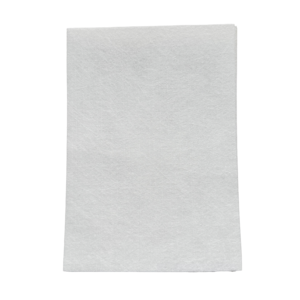
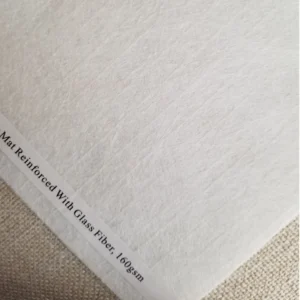
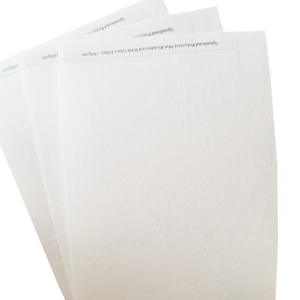
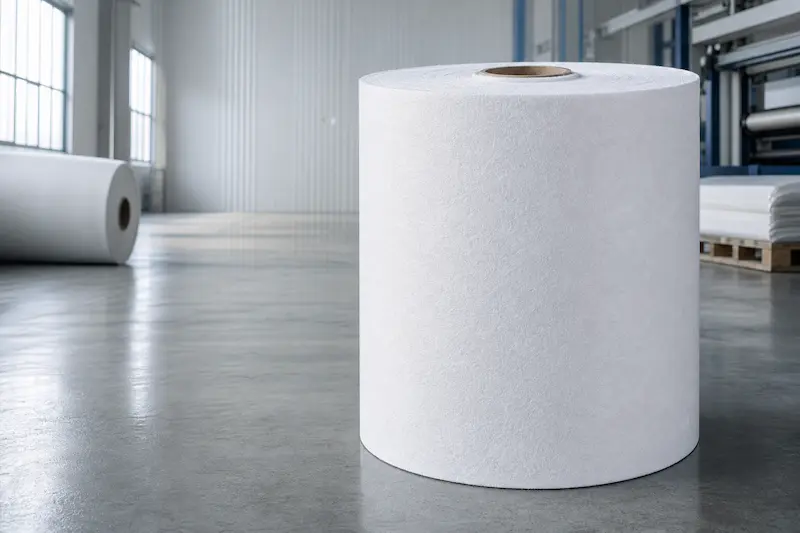
A polyester mat (also called spunbond polyester mat or nonwoven base fabric) is the reinforcement layer laminated inside modified bituminous membranes. It is produced by spinning polyester filaments, laying them into a web, and bonding them thermally or mechanically. The result is a uniform, high-strength sheet that gives the membrane its dimensional stability, puncture resistance and tensile performance.
Guanlong offers two main grades, both worth comparing side by side:
- Spunbond Polyester Mat — the standard workhorse for SBS and APP membranes.
- Reinforced Spunbond Polyester Mat — a reinforced version with an embedded scrim or grid for higher loads.
Before you compare prices, you need a spec sheet you actually understand. The three headline numbers below are where that understanding starts.
GSM: The First Decision
GSM (grams per square metre) is the basis weight of the mat. It is the first number on any spec sheet because it drives both cost and performance — and it is the number suppliers love to quote low.
Here is how common GSM ranges behave in practice:
| GSM range | Typical use | What to expect |
|---|---|---|
| 100–120 g/m² | Light membranes, repair sheets, low-cost systems | Lower tensile, thinner coating build, price-led |
| 150–180 g/m² | Standard SBS/APP membranes | Balanced strength and cost — the most common choice |
| 200–250 g/m² | High-performance and reinforced membranes | Higher tensile, better puncture resistance, heavier rolls |
For example, a 250 g/m² polyester mat roughly doubles the tensile contribution of a 120 g/m² mat — but the price does not double. As a result, the cost-performance sweet spot for most producers sits in the 150–180 g/m² band.
Keep in mind that GSM alone does not guarantee quality. Two rolls with the same nominal GSM can differ dramatically in uniformity — a point we examine in detail in Common Polyester Mat Defects and What They Mean for Your Membrane. Therefore, always ask for the actual measured GSM range (e.g. 170 ± 5 g/m²), not just a nominal figure.
Tensile Strength: The Number That Carries the Roof
Tensile strength measures how much force the mat can withstand before it breaks, typically expressed in N/5cm in both machine direction (MD) and cross direction (CD). It is tested with the strip method described in ISO 9073-3 for nonwovens, and the finished membrane is verified against methods in ASTM D5147 for modified bituminous sheets.
Why does tensile strength matter so much?
- During production — low tensile mat stretches or tears on the coating line, causing downtime and scrap.
- During handling — weak mat leads to edge tearing when rolls are lifted, moved or cut.
- On the roof — the membrane must resist structural movement, thermal cycling and foot traffic. If the base mat fails, the whole sheet fails.
A good rule of thumb: for standard SBS membranes, look for MD tensile in the region of 250–400 N/5cm depending on GSM; for reinforced grades, expect higher. Moreover, always check the MD/CD ratio — a mat with wildly different machine and cross strengths can behave unpredictably during lamination. In contrast, a balanced mat (ratio close to 1:1 or within 20%) processes more smoothly.
Elongation: Strength You Can Bend
Elongation is the percentage the mat can stretch before it breaks. If tensile strength is how hard the mat pulls, elongation is how far it can bend before snapping.
This parameter is critical for two reasons:
- Membrane flexibility — SBS-modified bitumen is designed to move with the substrate. A stiff base mat defeats that design, so a mat with good elongation (typically 20–40% at break for spunbond polyester) keeps the membrane flexible at low temperatures.
- Processing — the mat must stretch slightly during coating without necking or tearing, especially around rollers and tension zones.
The relationship matters more than either number alone: a mat with high tensile but almost no elongation will crack under movement; a mat with high elongation but low tensile will deform permanently. Consequently, the two specifications should always be read together.
Secondary Specs That Quietly Cause Defects
Beyond the three headline numbers, a few secondary parameters decide whether your line runs smoothly:
- Heat shrinkage — the mat must stay dimensionally stable at coating temperatures (160–200 °C). High shrinkage pulls the mat out of shape mid-line.
- Absorbency / wicking — how well bitumen penetrates and bonds with the fabric. Poor wet-out creates delamination later.
- Thickness uniformity — variations across the width create weak bands and uneven coating build.
- Roll joins and edges — bad joins cause line stops; rough edges cause waste.
Each of these can be traced in our production notes on How Guanlong Controls Quality from Raw Fiber to Finished Roll, because consistency — not just the average value — is what separates a good mat from a gamble.
How to Spec for Your Membrane System
Your chosen membrane system changes the target numbers:
- SBS membranes favour polyester mats with balanced tensile and good elongation, because the system relies on flexibility at low temperature.
- APP membranes can tolerate stiffer reinforcement, so cost can be optimised more aggressively.
- Self-adhesive membranes demand tight thickness and surface uniformity for clean release and adhesion.
If you are deciding between fabric families altogether, our comparison — Compound Base Mat vs. Polyester Mat: Which Carrier Fabric Is Right for Your Bitumen Membrane? — explains when a grid-type base mat makes more sense than a spunbond polyester mat.
A Practical Spec Checklist
When you evaluate any polyester mat supplier, ask for these five things:
- Measured GSM range (not nominal) with a test certificate per roll.
- Tensile strength in MD and CD (N/5cm), tested to ISO 9073-3.
- Elongation at break in MD and CD.
- Heat shrinkage at your coating temperature.
- A physical sample — never buy a base mat unseen.
Finally, remember that the cheapest mat per kilogram is rarely the cheapest mat per square metre of good membrane. For a free consultation on which polyester mat fits your line, contact our Guanlong sales team or request samples and certificates from the polyester mat product page.