The carrier fabric inside a waterproofing membrane rarely gets the credit it deserves. When a membrane fails, most buyers blame the bitumen coating; in reality, the fabric layer usually tells the real story. Producers today face a recurring decision between two leading options — compound base mat and polyester mat — and that choice shapes tensile strength, dimensional stability, production speed, and final cost. This guide compares both carrier fabrics head to head, so you can decide which one fits your bitumen membrane line.
What Is a Compound Base Mat?
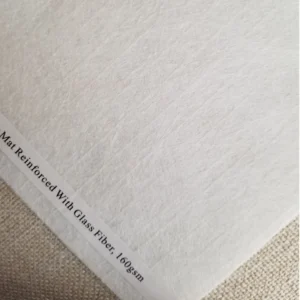
A compound base mat combines a fiberglass leno scrim with polyester nonwoven layers into one composite reinforcement. During production, the manufacturer compounds the fiberglass mesh into the nonwoven web, then dries and finalizes it at high temperature to lock the layers together. As a result, the material delivers the rigidity of glass fiber and the handling convenience of a nonwoven.
Manufacturers offer this material in several mesh densities, from 4×4 up to 8×8 (and even 9×9 in some lines), with basis weights ranging from roughly 130 g/m² to 200 g/m². For example, Guanlong’s 4×4 compound base mat delivers tensile strength of ≥450/400 N/5cm in machine and cross directions, while the 8×8 grade offers ≥300/260 N/5cm. Both maintain heat resistance above 150°C, which suits the hot coating and lamination stages of membrane production.
What Is a Spunbond Polyester Mat?
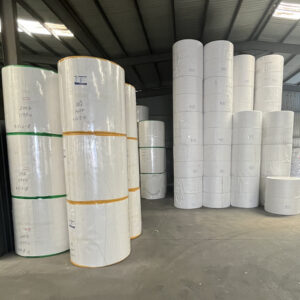
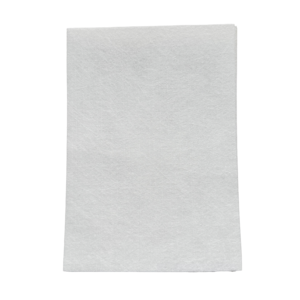
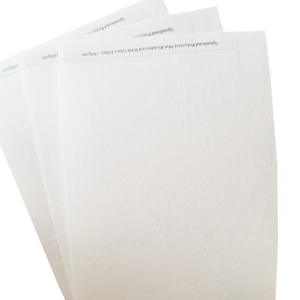
A spunbond polyester mat starts as continuous PET filaments. The process spins, bonds, and shapes these filaments into a light, flexible nonwoven sheet. Because the material contains no scrim layer, it behaves differently from a compound base mat: more elastic, more forgiving, and generally lighter.
Standard grades run from 120 g/m² to 160 g/m², with the 140g spunbond polyester mat a popular middle choice. This grade offers tensile strength of ≥230/200 N/5cm and elongation at break of at least 18%. The higher elongation matters for membranes that must flex without cracking, and the smooth surface improves coating adhesion.
Compound Base Mat vs. Polyester Mat: Key Differences
The table below summarizes how the two carrier fabrics compare across the specs that matter most to membrane producers:
| Property | Compound Base Mat | Spunbond Polyester Mat |
|---|---|---|
| Structure | Fiberglass leno scrim + polyester nonwoven | Continuous PET filament nonwoven |
| Tensile strength (typical) | ≥300–450 N/5cm (grade-dependent) | ≥230 N/5cm (140g grade) |
| Elongation at break | Lower, stiffer | ≥18%, more flexible |
| Dimensional stability | Excellent, minimal shrinkage | Good, but more stretch |
| Heat resistance | ≥150°C | ≥150°C |
| Basis weight range | 130–200 g/m² | 120–260 g/m² |
| Relative cost | Competitive, value-oriented | Low entry cost |
| Best fit | Heavy civil, tunnels, bridges, multi-layer | Standard roofing, flexible systems, vapor barriers |
When to Choose Compound Base Mat
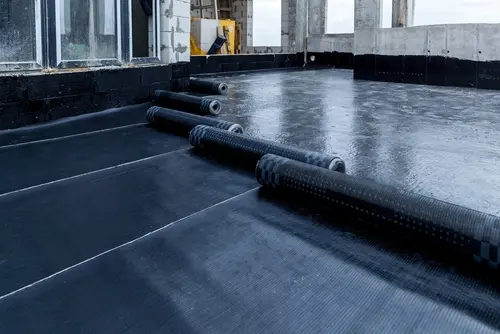
Choose a compound base mat when dimensional stability and tear resistance outweigh flexibility. The embedded fiberglass scrim keeps the membrane flat and true during coating, so the finished roll stays dimensionally stable through production and installation. This advantage proves critical in heavy civil projects — tunnels, bridges, and underground structures — where movement and puncture risk run high.
Moreover, the composite structure carries high tensile loads in both machine and cross directions, which lets producers run coating lines at higher speeds without fabric distortion. For multi-layer membranes or compound felt systems, the added reinforcement also improves layering integrity. Finally, the competitive price point makes the compound base mat attractive for high-volume standard production.
When to Choose Polyester Mat
Choose a spunbond polyester mat when flexibility and cost efficiency drive your product strategy. Because the mat stretches more before breaking, membranes built on it tolerate thermal movement and structural deflection without cracking — a key requirement for many roofing applications.
The material also supports production economics. Its lightweight construction reduces freight cost, and its recyclable PET content strengthens your sustainability story. For budget roofing underlayment, vapor barrier layers, or standard APP/SBS membranes where extreme puncture resistance matters less, the polyester mat delivers dependable performance at the lowest material cost. In practice, our gram weight guide explains how 120g, 140g, and 160g grades differ.
How to Verify Your Choice Before Committing
Whichever carrier fabric you lean toward, verify the physical properties before you buy. Tensile strength, elongation, and oil absorption determine how the fabric behaves under hot bitumen saturation. Our guide on testing polyester mat quality covers the key checks, and our article on how mat strength translates into membrane performance shows why these numbers predict real-world results.
Request samples and run a small trial on your own coating line. Test the same membrane formulation with both a compound base mat and a polyester mat, then compare coating uniformity, roll flatness, and tear resistance in the finished product. Data from your line beats any spec sheet.
Sourcing with Confidence: Work with a Specialist
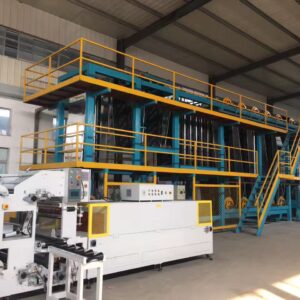
The supplier matters as much as the material. Weifang Guanlong Waterproof Material Co., Ltd. has specialized in waterproof membrane base materials since 2005, producing compound base mat, spunbond polyester mat, fiberglass mesh, and complete production lines from its Shandong factory. The company exports to Asia, the Middle East, and Europe, and it customizes weight, width, and roll length to match each producer’s line.
Browse the full compound base mat range and the polyester mat category to compare options, or explore our comparison of polyester vs. fiberglass reinforcement for a third angle. When you are ready to test, contact our team for samples and technical guidance.
Frequently Asked Questions
1. What is the difference between a compound base mat and a polyester mat?
A compound base mat combines a fiberglass leno scrim with polyester nonwoven layers, giving it higher tensile strength and better dimensional stability. A polyester mat uses only continuous PET filaments, offering greater flexibility and a lower cost.
2. Which carrier fabric has higher tensile strength?
Compound base mat generally wins on tensile strength. Typical grades deliver 300–450 N/5cm, whereas a standard 140g polyester mat reaches about 230 N/5cm.
3. Can I use a compound base mat for APP-modified bitumen membranes?
Yes. Compound base mat works well with both SBS and APP modified bitumen systems, and its thermal stability suits high-temperature coating processes. You can read more about bituminous waterproofing systems in general here.
4. How do I choose between 4×4, 6×6, and 8×8 mesh counts?
Higher mesh counts (8×8) pack more fiberglass into the scrim, raising tear resistance and stability, while lower counts (4×4) offer a lighter, more cost-efficient structure. Choose based on your membrane’s required strength and budget.
5. Can Guanlong customize the weight and width of base mat?
Yes. Guanlong adjusts basis weight, width, and roll length according to customer requirements, and its team offers technical guidance on material selection.
6. How do I request samples?
Contact the Guanlong team through the website form or WhatsApp, describe your membrane formulation and line speed, and the team will recommend the right grade and arrange samples.
Conclusion
Compound base mat vs polyester mat is not a contest with a single winner; it is a fit question. Choose the compound base mat for dimensional stability, high tensile strength, and cost-efficient reinforcement in demanding projects. Choose the polyester mat for flexibility, lightweight handling, and budget-friendly production. Evaluate both on your line, confirm with samples, and source from a specialist who understands membrane production — then your carrier fabric decision stops being a gamble.