The reinforcement layer decides how a bitumen membrane performs for the next 20 to 50 years. When we compare polyester mat vs fiberglass mat, we are really comparing two engineering philosophies: flexibility that absorbs movement versus stiffness that resists heat. Manufacturers of SBS and APP membranes must choose the right carrier, because the wrong pick leads to cracking, blistering, or premature failure. This guide breaks down the technical differences and shows exactly when to select each material — and when a hybrid makes more sense.
What Is Fiberglass Mat?
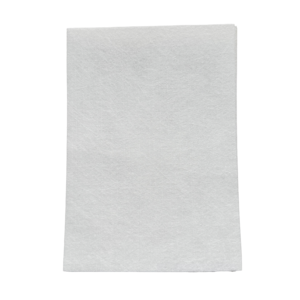
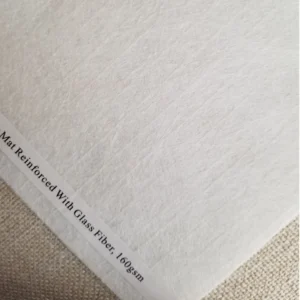
Manufacturers form fiberglass mat from fine glass filaments bonded into a uniform web. Glass fibers bring two outstanding properties to membrane production:
- Exceptional heat resistance. Glass tolerates the high temperatures of bitumen coating and lamination without shrinking or losing shape.
- High tensile strength. The mat carries heavy loads along the machine direction with minimal stretch.
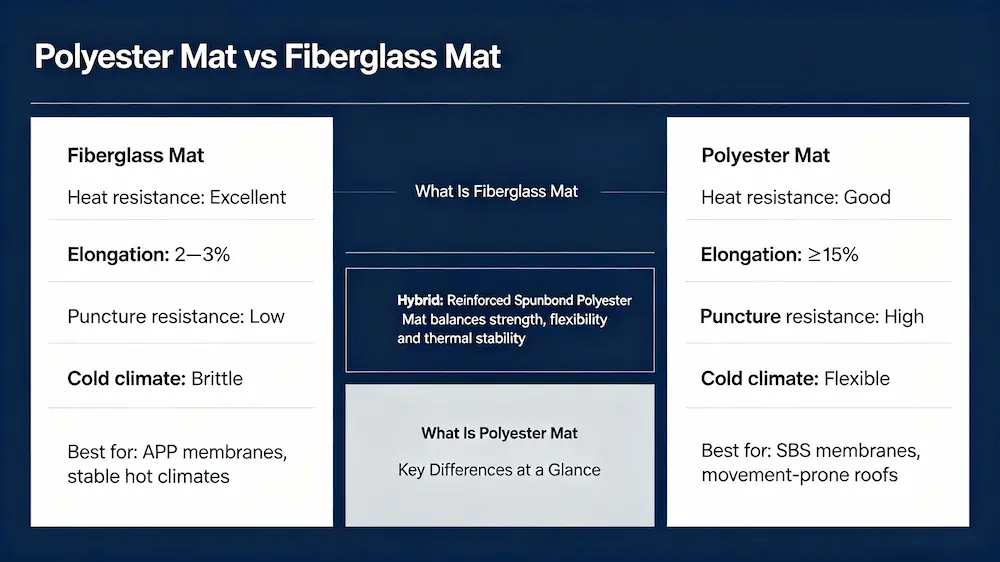
However, glass has a significant weakness: it stretches very little. Fiberglass mat typically offers only 2–3% elongation at break. Consequently, when a roof moves, expands, or settles, a glass-reinforced membrane cannot follow that movement. The result is cracking at joints and corners, especially in climates with large temperature swings. Glass mat also offers limited puncture resistance, so heavy foot traffic during installation can damage the membrane before it even serves its purpose.
What Is Polyester Mat?
Polyester mat starts from continuous PET filaments laid into a web through the spunbond process. As EDANA explains, this technology produces engineered fabrics with predictable mechanical properties. Polyester mat excels in exactly the areas where glass falls short:
- High elongation. Polyester filaments stretch and recover, so the membrane bridges substrate cracks instead of tearing.
- Excellent puncture and tear resistance. The fabric survives construction traffic and sharp gravel without damage.
- Cold-climate flexibility. Polyester stays supple at low temperatures, where glass becomes brittle.
- Rot and mildew resistance. The synthetic fibers resist biological degradation in damp conditions.
The trade-off: standard polyester mat offers lower thermal dimensional stability than glass at very high lamination temperatures. That limitation matters only for high-heat processes, and manufacturers solve it with a reinforced construction, which we cover below.
Polyester Mat vs. Fiberglass Mat: Key Differences at a Glance
Where Fiberglass Mat Excels
Choose fiberglass mat when the membrane will face steady, rigid conditions with little thermal movement. Typical applications include:
- APP membranes with high softening points, where heat resistance matters most.
- Hot-climate roofing in regions with minimal freeze-thaw cycling.
- Cost-sensitive projects where the lower material price outweighs flexibility needs.
Notably, glass-reinforced membranes still serve millions of square meters of roofing worldwide. If your production line and target market match these conditions, fiberglass remains a legitimate, economical option.
Where Polyester Mat Excels
Choose polyester mat whenever the membrane must tolerate movement, cold, or rough handling:
- SBS membranes, which combine polymer flexibility with a carrier that can stretch with it.
- Cold and temperate climates, where freeze-thaw cycles crack brittle carriers.
- Structures prone to settlement or thermal expansion, such as large industrial roofs and bridges.
- High-traffic installations, where puncture resistance during construction prevents early failure.
In addition, polyester’s durability extends service life, which directly supports sustainable construction. Read our guide on why long-fiber polyester mat leads sustainable construction to see how a longer-lasting carrier lowers the lifecycle carbon footprint of a building.
The Hybrid Answer: Reinforced Spunbond Polyester Mat
For many manufacturers, the polyester mat vs fiberglass mat choice no longer requires a compromise. Reinforced spunbond polyester mat combines both materials: longitudinal fiberglass strands sit between two layers of polyester fiber mesh, and needle punching bonds them into one composite. The hybrid delivers:
- Glass-level tensile strength in the machine direction, reaching ≥ 260 N/5cm at 140 g/m².
- Polyester-level elongation of ≥ 15%, so the membrane still absorbs movement.
- Thermal stability of ≥ 150°C, which supports high-speed production lines without distortion.
Our 140g Reinforced Spunbond Polyester Mat demonstrates this balance, and the reinforced range extends from 120g to 250g for heavier-duty applications. Guanlong also customizes gram weights from 120g to 260g to match your exact production targets — see how we customize base mat lines for 120g to 260g specs.
As a result, many membrane makers now run reinforced spunbond as their default carrier for both SBS and APP systems, reserving pure fiberglass for niche cost-driven lines and standard polyester for maximum-flexibility products.
Standards That Define the Choice
Whatever carrier you select, verify its performance against recognized standards. EN 13707:2013 specifies requirements for reinforced bitumen sheets used in roof waterproofing, while ASTM D5147 covers sampling and testing methods for modified bituminous sheet materials. Ask your supplier for test reports that document tensile strength, elongation, and heat resistance under these frameworks.
FAQ
Is fiberglass mat stronger than polyester mat?
In raw tensile terms, fiberglass mat shows high strength with almost no stretch, while polyester mat delivers high strength with 15% or more elongation. For real-world roofing, “stronger” usually means “survives movement without cracking,” which favors polyester and reinforced spunbond polyester mat.
Why does fiberglass mat crack in cold climates?
Glass fibers elongate only 2–3% before breaking. When temperature changes make a roof deck expand and contract, a glass-reinforced membrane cannot flex, so stress concentrates at joints and eventually cracks the reinforcement.
Which reinforcement lasts longer: fiberglass or polyester?
Polyester generally lasts longer in service because it resists fatigue, puncture, and low-temperature brittleness. Its durability extends membrane service life from a typical 10–15 years toward 30–50 years, which also reduces lifecycle environmental impact.
Can I use one carrier for both SBS and APP membranes?
Yes. Reinforced spunbond polyester mat combines glass-level heat stability with polyester flexibility, so it runs successfully on both SBS and APP production lines. Many manufacturers now standardize on this hybrid carrier.
What reinforcement materials does Guanlong supply?
Guanlong supplies spunbond polyester mat, reinforced spunbond polyester mat, fiberglass mat, compound base mat, and polyester felt. Browse the full product range or contact our team for specifications and samples.
Conclusion: Match the Carrier to the Real-World Stress
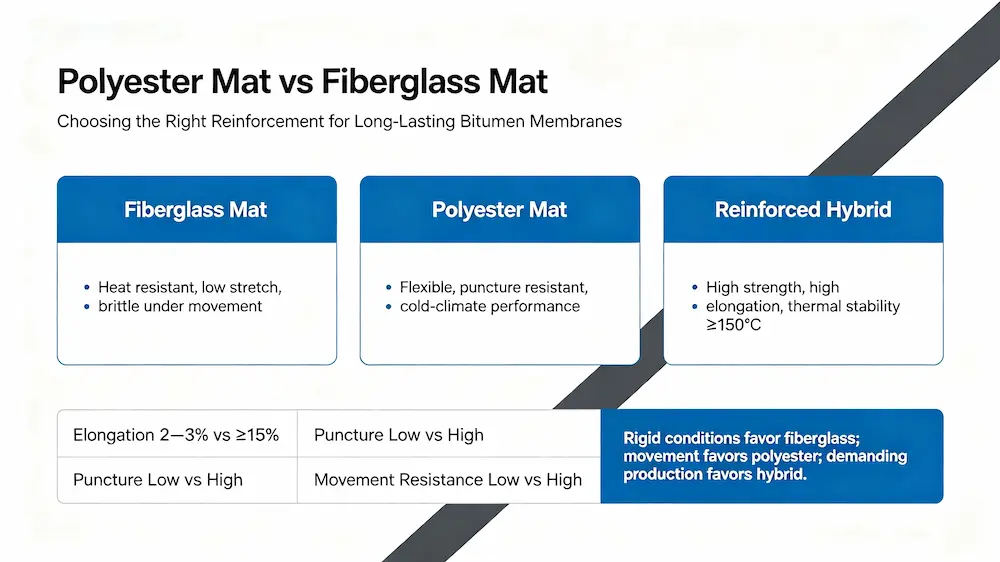
The polyester mat vs fiberglass mat decision comes down to one question: what will the installed membrane face? Rigid, hot, stable conditions favor fiberglass; movement, cold, and rough handling favor polyester; and demanding high-output production favors the hybrid reinforced construction. None of these materials is universally superior — the right reinforcement matches your line, your market, and the stresses your roofs will carry.
At Guanlong Waterproof, we manufacture all three carrier types on advanced production lines with strict quality control and nearly 20 years of waterproofing expertise. Explore our polyester mat range or contact us to discuss your next order.