Ask any membrane producer about their carrier fabric and the first number they quote is the gram weight. 120g, 140g, 160g — these figures appear on every datasheet and every quotation. Yet many buyers treat them as interchangeable labels rather than meaningful specifications. In reality, the polyester mat gram weight determines tensile strength, dimensional stability, material cost, and which production lines the fabric can serve. This guide decodes each weight, shows you exactly what it delivers, and helps you match the spec to your membrane program.
What Does Gram Weight (GSM) Actually Mean?
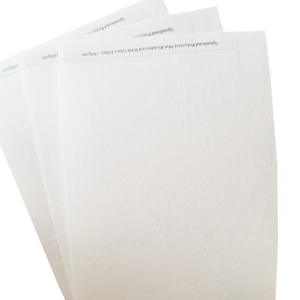
Gram weight measures grams per square meter (g/m², often written as GSM). Simply put, it tells you how much polyester fiber sits in one square meter of fabric. A heavier mat packs more filaments into the web, which generally translates into higher strength and a thicker, denser carrier. As EDANA explains, nonwoven manufacturers engineer these fabrics by controlling fiber deposition, and gram weight is the single most visible control point.
However, weight alone does not tell the whole story. Two mats at the same gram weight can perform very differently depending on construction — standard spunbond versus reinforced spunbond, for example. So treat gram weight as the starting point, not the final answer.
The 120g Polyester Mat: Light, Economical, Entry-Level
The 120g reinforced spunbond polyester mat represents the lightest practical carrier for modified bitumen membranes. Its ultra-light structure keeps material costs down and makes the fabric easy to handle and transport. Despite the low basis weight, the fiberglass reinforcement lifts performance well above what an unreinforced fabric of the same weight could offer.
Our 120g Reinforced Spunbond Polyester Mat delivers:
- Tensile strength (MD/CD): ≥ 220 / 200 N/5cm
- Elongation at break: ≥ 13%
- Heat resistance: ≥ 150°C
This spec suits entry-level SBS and APP membrane production, residential roofing underlayment, and compound felt base layers. If your market competes mainly on price and the projects are non-critical structures, 120g keeps the bill of materials lean.
The 140g Polyester Mat: The Balanced Workhorse
The 140g reinforced spunbond polyester mat sits at the sweet spot of the range, which explains why it dominates international membrane production. It adds roughly 15% more tensile strength than the 120g grade while staying economical enough for high-volume lines.
Our 140g Reinforced Spunbond Polyester Mat delivers:
- Tensile strength (MD/CD): ≥ 260 / 230 N/5cm
- Elongation at break: ≥ 15%
- Heat resistance: ≥ 150°C
For standard SBS and APP systems, general roofing, and commercial underlayment, 140g provides the best balance of strength, flexibility, and cost. Notably, the standard 140g Spunbond Polyester Mat (without fiberglass core) still reaches ≥ 230/200 N/5cm with ≥ 18% elongation, making it a strong option for maximum-flexibility applications at the same weight.
The 160g Polyester Mat: Heavy-Duty Performance
When the membrane must survive demanding conditions, the 160g reinforced spunbond polyester mat steps in. The extra fiber content raises both tensile strength and elongation, giving the membrane more reserve capacity against punctures, thermal cycling, and structural movement.
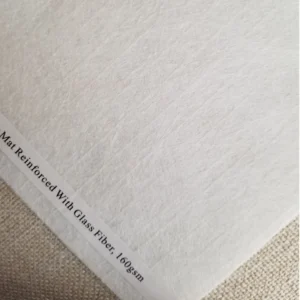
Our 160g Reinforced Spunbond Polyester Mat delivers:
- Tensile strength (MD/CD): ≥ 300 / 270 N/5cm
- Elongation at break: ≥ 18%
- Heat resistance: ≥ 150°C
This grade suits heavy-duty roofing, infrastructure projects, and membranes that face heavy foot traffic during installation. For even higher demands, the range extends to 200g, 250g, and 260g reinforced grades.
120g vs 140g vs 160g at a Glance
| Spec (Reinforced Grade) | 120g | 140g | 160g |
|---|---|---|---|
| Basis weight | 120 g/m² | 140 g/m² | 160 g/m² |
| Tensile strength MD/CD | ≥ 220 / 200 N/5cm | ≥ 260 / 230 N/5cm | ≥ 300 / 270 N/5cm |
| Elongation at break | ≥ 13% | ≥ 15% | ≥ 18% |
| Heat resistance | ≥ 150°C | ≥ 150°C | ≥ 150°C |
| Relative cost | Lowest | Moderate | Higher |
| Typical use | Entry-level membranes, underlayment | Standard SBS/APP roofing | Heavy-duty and infrastructure |
Why Gram Weight and Construction Work Together
A common mistake: assuming a heavier standard spunbond mat automatically outperforms a lighter reinforced one. In fact, construction matters as much as weight. The fiberglass core in reinforced mats provides glass-level stiffness, so a 120g reinforced fabric can offer better dimensional stability under heat than a 140g unreinforced fabric. Therefore, define both parameters — gram weight AND construction — when you source. Our polyester mat category lists standard and reinforced grades side by side so you can compare them directly.
How to Choose the Right Gram Weight
Match the gram weight to four factors:
- Membrane type and quality grade. Premium SBS systems justify 140g–160g carriers; entry-level products run on 120g.
- Production line speed. Heavier fabrics feed stiffer, so confirm the fabric handles your line tension without stretching.
- Substrate and climate. Movement-prone roofs and cold climates benefit from the higher elongation of 140g and 160g grades.
- Target cost per square meter. The carrier typically represents a significant share of membrane material cost — weight choice directly moves your margin.
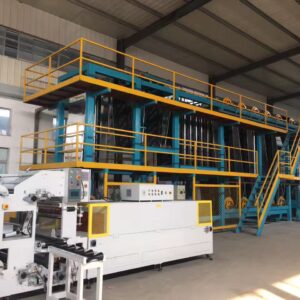
In addition, you are not locked into off-the-shelf weights. Guanlong customizes base mat production from 120g to 260g, so you can tune the spec to your exact formula. See how we customize base mat lines for 120g to 260g specs.
Verify Beyond the Label
A printed “140g” on the datasheet means little without verification. Check three things before ordering:
- Actual GSM. Weigh samples from different rolls; a reliable supplier stays within a tight tolerance of the labeled value.
- Tensile test reports. Confirm MD/CD values match the claimed spec. ASTM D5147 provides recognized test methods for modified bituminous sheet materials, while EN 13707:2013 defines performance requirements for reinforced bitumen sheets.
- Batch consistency. Ask whether the supplier records and traces production data per batch.
FAQ
What does GSM mean for polyester mat?
GSM (grams per square meter) measures how much fiber the fabric contains. It correlates with thickness, strength, and cost: heavier mats generally deliver higher tensile strength but cost more per square meter.
Is a heavier polyester mat always better?
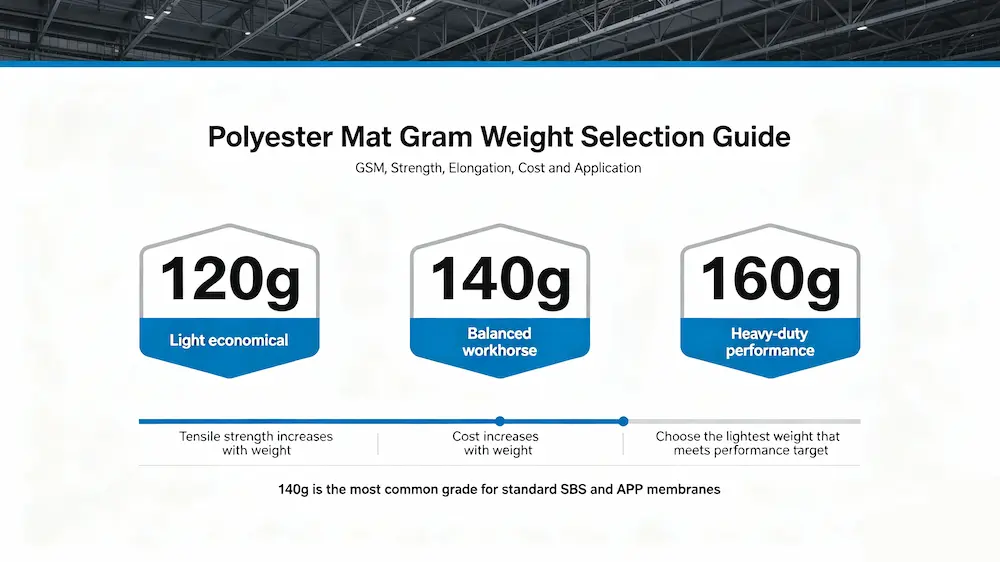
No. Heavier mats add strength and stiffness, but they also raise cost and reduce elongation flexibility if over-specified. Choose the lightest weight that meets the membrane’s performance target — many standard roofing membranes run perfectly on 140g.
Which polyester mat gram weight is most popular?
140g is the most common grade for standard SBS and APP membranes worldwide. It balances tensile strength (≥ 260/230 N/5cm in reinforced form), elongation, and cost for high-volume production.
Can I get custom gram weights?
Yes. Guanlong customizes base mat production from 120g to 260g to match your formula, line speed, and cost targets.
How do I verify the actual gram weight of a delivered roll?
Weigh a sample of known area and divide by the area to get GSM. For meaningful results, sample multiple positions across the roll width and compare rolls from the same batch.
Conclusion: Match the Spec to the Application
The polyester mat gram weight is not a vanity number — it is the single most influential spec on your membrane’s strength, cost, and production behavior. Choose 120g for lean entry-level economics, 140g for the balanced workhorse performance most markets demand, and 160g or above for heavy-duty and infrastructure duty. Pair the weight with the right construction, verify the delivered material, and your membrane program runs on a solid foundation.
Guanlong Waterproof has supplied polyester mats in gram weights from 120g to 260g since 2005, backed by strict quality control and nearly 20 years of waterproofing expertise. Browse the full polyester mat range or contact us for samples and a quotation.