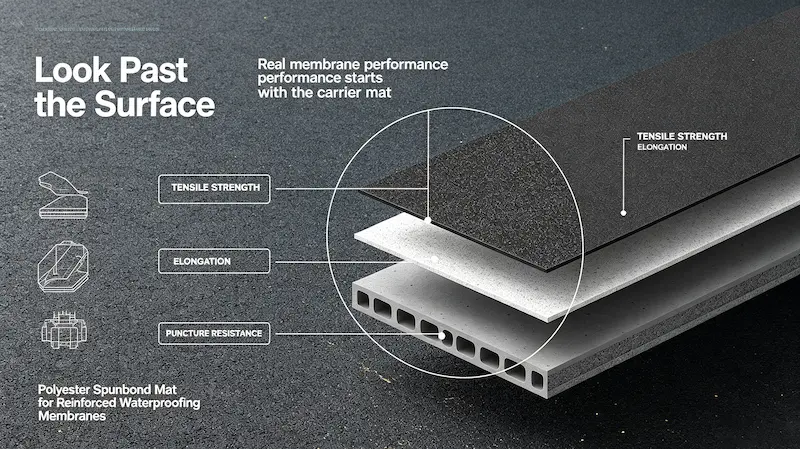
Buyers often judge a waterproofing membrane by its surface: the bitumen coating, the finish, the brand. But the membrane’s real performance — how long it survives wind uplift, thermal movement, and job-site abuse — comes from what sits underneath. The carrier fabric carries the load. In this article, we translate the three most important carrier specs — tensile strength, elongation, and puncture resistance — into the real-world membrane behavior they produce. Understand these numbers, and you can predict how a membrane will perform before it ever reaches a roof.
Tensile Strength: The Load-Bearing Backbone
Tensile strength measures how much force the fabric withstands before it tears, expressed in newtons per 5 centimeters (N/5cm) and reported separately for the machine direction (MD) and cross direction (CD). This number drives several critical membrane behaviors:
- Wind uplift resistance. A membrane bonded to a roof deck experiences constant pull. Higher tensile strength keeps the reinforcement intact when wind loads peak.
- Handling on the production line. The carrier must survive the tension of coating, cooling, and winding without stretching out of spec. Stronger fabrics run faster and more reliably.
- Thermal stress absorption. As the roof expands and contracts, the reinforcement resists the forces that would otherwise tear the membrane apart.
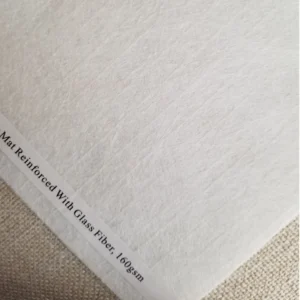
For a benchmark, our 140g Reinforced Spunbond Polyester Mat delivers ≥ 260/230 N/5cm (MD/CD). The 160g grade reaches ≥ 300/270 N/5cm for heavy-duty duty. Notably, industry test methods such as ASTM D5147 standardize how manufacturers measure these values, so the numbers on a datasheet mean the same thing across suppliers.
Elongation: Following the Substrate Without Cracking
Elongation at break tells you how far the fabric stretches before failing. This spec determines whether a membrane cracks or bridges when the substrate moves. Consider a concrete roof deck that develops a hairline crack: a low-elongation carrier transfers that movement straight into the membrane, which then splits. A high-elongation carrier stretches with the movement and keeps the waterproofing intact.
Polyester excels here precisely because of its filament structure. The 140g Spunbond Polyester Mat offers ≥ 18% elongation, while reinforced grades still provide ≥ 15% at 140g and ≥ 18% at 160g. As a result, polyester-based membranes bridge structural movement far more reliably than brittle carriers. Cold climates especially favor this property: flexible carriers do not shatter at low temperatures, so the membrane keeps its integrity through freeze-thaw cycles.
Puncture Resistance: Surviving the Job Site
The most common cause of membrane failure happens before the roof is even finished. Workers walk on the membrane, drop tools, drag equipment, and place sharp gravel — and every one of these actions tests the carrier’s puncture and tear resistance. A mat that punctures easily creates a leak that often goes unnoticed until the interior damage appears.
Polyester mat resists punctures through two mechanisms: filament density and elongation. The filaments distribute localized pressure across a wider area, while the fabric’s stretch lets it deform around a sharp point instead of tearing. Heavier grades add more protection: the 160g Reinforced Spunbond Polyester Mat combines the fiberglass core’s stiffness with a denser polyester web, giving installers real margin for error.
From Mat Spec to Membrane Behavior: The Translation Table
| Mat Property | Membrane Benefit | Field Result |
|---|---|---|
| High tensile strength (MD/CD) | Resists tearing under load | Survives wind uplift and thermal stress |
| High elongation at break | Bridges substrate movement | No cracking over joints and hairline cracks |
| High puncture resistance | Withstands construction abuse | Fewer leaks, fewer repairs, longer service life |
| Good dimensional stability | Holds shape under heat | Clean lamination, consistent thickness |
| Uniform surface | Even bitumen saturation | Consistent adhesion, no weak spots |
Why Construction Matters as Much as the Numbers
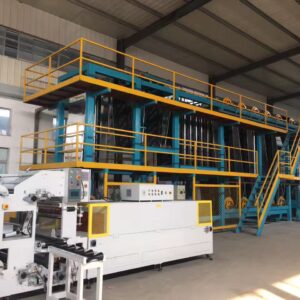
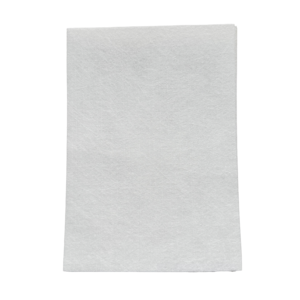
Two mats with identical tensile strength can still behave differently, because construction shapes how that strength expresses itself. Standard spunbond polyester mat distributes its strength evenly in all directions, maximizing flexibility. Reinforced spunbond polyester mat adds a longitudinal fiberglass core, which raises stiffness and thermal dimensional stability while keeping most of the elongation. Consequently, you should select not just a strength number but a construction that matches your membrane system and production line. Our polyester mat category compares standard and reinforced grades side by side.
Moreover, you can tune both parameters together. Guanlong customizes base mat production from 120g to 260g, letting you balance tensile strength, elongation, and cost for your exact formula. See how we customize base mat lines for 120g to 260g specs.
Testing and Verification: Trust the Report, Not the Label
Three habits keep your membrane program honest:
- Request MD and CD values separately. Some suppliers quote only the stronger direction; the cross direction matters equally in service.
- Check elongation alongside tensile. High strength with low elongation can still crack — both specs must fit your application.
- Ask for reports under recognized standards. EN 13707:2013 defines requirements for reinforced bitumen sheets, and ASTM D5147 covers the test methods behind the numbers.
FAQ
What does MD/CD tensile strength mean?
MD (machine direction) and CD (cross direction) report tensile strength along and across the fabric roll. A good carrier delivers strong values in both directions, because stresses on a roof never arrive from one direction only.
Does higher elongation always mean a better polyester mat?
Not always, but usually for roofing. Higher elongation helps the membrane bridge cracks and survive cold climates. For very stiff systems such as certain APP membranes, moderate elongation with high dimensional stability may suit better — match the spec to the system.
How does polyester mat puncture resistance relate to gram weight?
Puncture resistance generally rises with gram weight because more filaments distribute pressure over a larger area. Reinforced constructions add further protection, which is why 160g reinforced grades suit high-traffic and infrastructure projects.
Why does a membrane crack if the mat has high tensile strength?
Cracking often comes from low elongation rather than low strength. If the carrier cannot stretch with substrate movement, the membrane splits even though the fabric never reached its tensile limit. Always evaluate tensile and elongation together.
How do I verify a supplier’s polyester mat tensile strength?
Request test reports performed under recognized methods such as ASTM D5147, and check both MD and CD values. You can also cut samples for independent testing before committing to a large order.
Conclusion: Read the Carrier, Predict the Membrane
The polyester mat tensile strength, elongation, and puncture resistance tell you more about a membrane’s future than any surface finish. Tensile strength keeps the membrane intact under load, elongation lets it follow a moving substrate, and puncture resistance protects it through installation and service. Understand these three numbers, verify them with real test reports, and your waterproofing systems perform as designed for decades.
Guanlong Waterproof has manufactured polyester mats with certified, consistent specs since 2005, backed by strict quality control and nearly 20 years of expertise. Explore the full polyester mat range or contact us for test reports and samples.