When a waterproofing membrane fails, most people blame the coating. The reality, however, tells a different story: the carrier fabric hidden inside the sheet usually decides how long the membrane survives. Bitumen seals; the carrier carries. Tensile loads, thermal movement, installation abuse, and puncture stress all land on the fabric layer first. Consequently, membrane lifespan depends far more on carrier fabric quality than on the bitumen formulation — and this article explains exactly why, and how to verify it before you buy.
How a Waterproofing Membrane Works: The Hidden Architecture
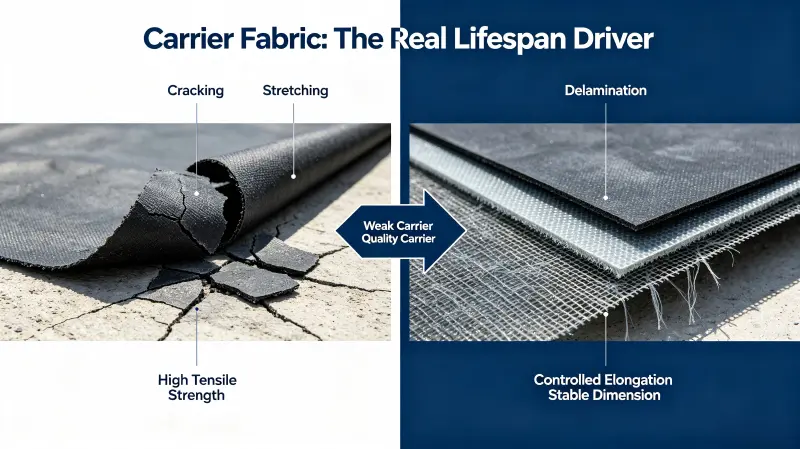
Think of a modified bitumen membrane as a sandwich. The top and bottom layers consist of bitumen — the polymer-modified coating that seals out water. Between them sits the carrier fabric: a reinforcement web of polyester, fiberglass, or a composite of both. This fabric provides the mechanical skeleton, while the bitumen provides the waterproof skin.
Bitumen alone cannot resist stretching, tearing, or puncturing; it behaves like a stiff, brittle mass at low temperatures and a soft one at high temperatures. The carrier fabric changes that. It absorbs the mechanical stress, holds the membrane together during movement, and keeps the sheet dimensionally stable during manufacturing and installation. In short, the coating fails from stress; the carrier fails from weakness — and weakness in the carrier shows up much sooner. For background on how bituminous systems evolved, see the Wikipedia overview of bituminous waterproofing.
The Five Ways Carrier Quality Controls Lifespan
Carrier fabric quality influences membrane performance through five measurable mechanisms:
1. Tensile strength. The fabric must resist stretching and tearing under structural movement, foot traffic, and wind uplift. A weak carrier stretches locally, thins the coating above it, and eventually splits. For example, Guanlong’s 4×4 compound base mat delivers ≥450/400 N/5cm in machine and cross directions, while its 8×8 grade offers ≥300/260 N/5cm — numbers that translate directly into how much abuse the finished membrane tolerates.
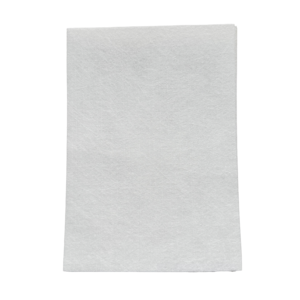
2. Elongation. Membranes must flex with thermal expansion and structural settlement without cracking. The 140g spunbond polyester mat, for instance, provides ≥18% elongation at break, which suits systems that move. A stiff, low-elongation carrier transfers stress straight to the coating and promotes cracking.
3. Dimensional stability. A carrier that shrinks during hot coating or after installation distorts the whole sheet. Dimensionally stable fabrics keep laps aligned and seams watertight for decades. Compound base mats excel here because the fiberglass scrim locks the structure in place.
4. Puncture and tear resistance. Sharp substrates, nails, and heavy equipment test the membrane during and after installation. Tear-resistant carriers survive that abuse; brittle ones start leaking at the first puncture site.
5. Bitumen absorption. The carrier must absorb and bond with the coating evenly. Poor absorption leaves dry spots and weak adhesion, which leads to delamination — the coating peeling away from the fabric — long before the bitumen itself ages.
Each mechanism ties back to measurable specs, and our article on how mat strength translates into membrane performance explains these connections in technical detail.
Why the Bitumen Isn’t the Weak Link
Bitumen quality certainly matters — polymer modification with SBS or APP changes flexibility and heat resistance. But here’s the practical reality: reputable suppliers worldwide use similar modified bitumen formulations. When you compare two membranes with identical coatings, the difference in lifespan comes almost entirely from the carrier.
Moreover, bitumen degrades predictably over time through UV exposure and oxidation; that aging affects all systems similarly. The carrier, by contrast, faces unpredictable loads — foot traffic, roof movement, thermal cycling, hail, and construction damage. A quality carrier absorbs those events and keeps the system intact; a weak one fails at the first serious test. In practice, then, you extend membrane lifespan most by upgrading the reinforcement, not by chasing a marginally “better” bitumen blend. NRCA roof-system guidance reaches the same conclusion: reinforcement and attachment detail drive long-term performance.
What Carrier Quality Looks Like on a Spec Sheet
A carrier datasheet reveals quality through a handful of numbers:
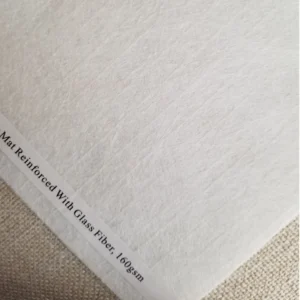
Gram weight. The basis weight (g/m²) indicates how much material supports the membrane. Higher weight generally means more strength, though the fiber type matters too. Our gram weight guide breaks down 120g, 140g, and 160g grades in practical terms.
Tensile strength (MD/CD). Read both directions. Big gaps between machine and cross values signal weaker performance across the roll width.
Elongation at break. Match the elongation to your application: flexible roofing needs more, rigid structures can tolerate less.
Heat resistance. The carrier must survive hot bitumen coating without shrinking or melting; look for ratings of 150°C or above.
Uniformity. Quality comes from consistent production. Roll after roll, the weight, width, and strength should stay within tight tolerances; inspection catches drift that spec sheets never show. Our guide to testing polyester mat quality details the checks buyers should run on every incoming batch.
Where Carriers Come From: Cotton, Polyester, Fiberglass, and Compound
The carrier’s evolution explains its importance. Decades ago, producers used cotton rags and organic felts — cheap, but weak and inconsistent. The industry then shifted to polyester spunbond nonwovens, which offered far better strength and durability; our article on polyester mat vs. cotton mat traces that transition. Meanwhile, fiberglass-based reinforcements brought dimensional stability, and modern compound base mat combines fiberglass scrim with polyester nonwoven to get both rigidity and toughness. If you want a third angle on this choice, see our comparison of polyester vs. fiberglass reinforcement.
Each carrier type suits different membranes, but the principle stays constant: the reinforcement defines the envelope of performance, and the coating simply fills in the gaps.
The Cost of a Weak Carrier
Weak carriers produce quiet failures that surface years later — and by then, they cost far more than the savings on material. Cracked membranes leak into insulation and structure. Delamination exposes the fabric to water, accelerating degradation. Dimensional instability pulls laps apart and opens seams. Warranty claims, re-roofing, and damaged reputations follow.
Consider the arithmetic: a premium carrier adds a small amount to each roll, but a single membrane failure can cost a hundred times that in repairs and labor. In other words, cheap reinforcement is the most expensive decision a producer or contractor can make.
How to Verify Carrier Quality Before You Buy
Verification takes three steps. First, request samples and check the physical specs — weigh a cut square, test tensile by hand, and inspect the surface for lumps, thin spots, and contamination. Second, run a trial on your own coating line: saturate the sample, measure shrinkage, and check coating uniformity. Third, audit the supplier’s quality control; consistent output matters as much as the headline numbers.
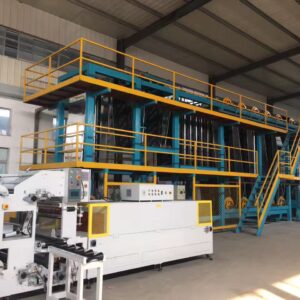
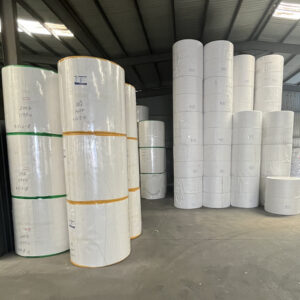
Weifang Guanlong Waterproof Material Co., Ltd. has manufactured waterproof membrane carriers since 2005, producing spunbond polyester mat, compound base mat, and fiberglass mesh from its Shandong factory, with exports across Asia, the Middle East, and Europe. The company customizes weight, width, and roll length, and its team provides technical guidance on material selection. To test a carrier on your line, contact the Guanlong team for samples and specifications.
Frequently Asked Questions
1. What is the carrier fabric in a waterproofing membrane?
The carrier fabric is the reinforcement layer inside the membrane, typically polyester nonwoven, fiberglass, or a composite. It carries mechanical stress while the bitumen coating provides the waterproof barrier.
2. Why does carrier quality matter more than bitumen quality?
Most suppliers use similar polymer-modified bitumen, so coating differences are small. Carriers, however, vary widely in tensile strength, elongation, and stability — and the carrier absorbs the real-world loads that decide lifespan.
3. What tensile strength should I look for in a membrane carrier?
Match the value to your application. Standard spunbond polyester grades offer around 230 N/5cm; compound base mats range from 300 to 450 N/5cm depending on mesh count. Higher loads demand higher tensile values.
4. What happens if the carrier fabric has low elongation?
The membrane stiffens and transfers stress to the coating, which cracks under thermal movement or structural settlement. Look for at least 15–18% elongation for flexible roofing systems.
5. How can I tell if a carrier fabric is high quality?
Check gram weight, tensile strength in both directions, elongation, heat resistance, and surface uniformity. Request samples, run a trial on your line, and audit the supplier’s quality control.
6. Where can I buy quality carrier fabrics?
Weifang Guanlong Waterproof Material Co., Ltd. supplies spunbond polyester mat, compound base mat, and fiberglass mesh with customizable specifications. Contact the team for samples and technical support.
Conclusion
Membrane lifespan follows the carrier, not the coating. Tensile strength, elongation, dimensional stability, tear resistance, and bitumen absorption — all properties of the hidden fabric — determine how long a membrane resists stress, movement, and abuse. So when you specify or buy membranes, look past the bitumen and examine the reinforcement: request samples, run trials, and source from manufacturers who control carrier quality from fiber to finished roll. That one decision extends membrane life more than any formulation tweak ever will.