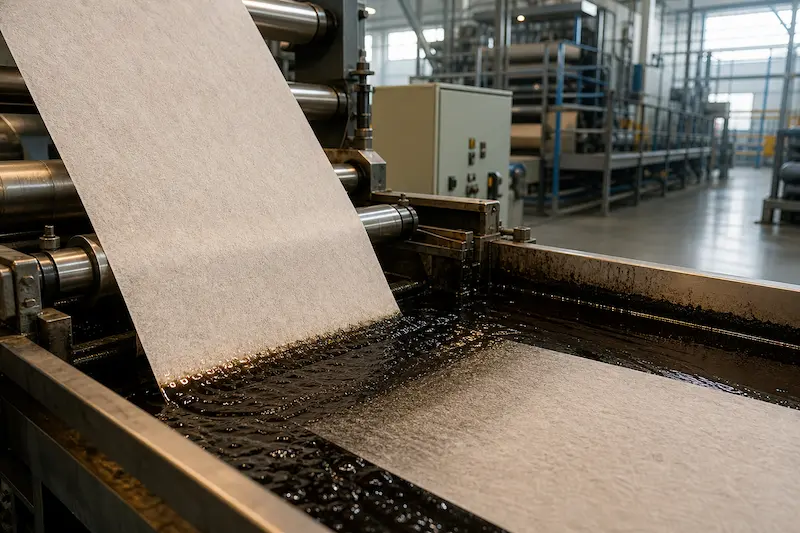
Bitumen prices move, and every membrane manufacturer feels it. Yet a quieter cost driver sits on your line every single shift: the carrier fabric you saturate. Two polyester mats can share the same gram weight, the same roll width, and a nearly identical price per kilogram — and still pull different amounts of bitumen into the finished sheet. Over a year of production, that difference lands on your cost sheet as a real number.
This article shows you how to measure bitumen uptake on your own line, how to convert the result into a cost figure, and how to decide whether a more expensive mat actually saves you money.
Why oil absorption is the hidden cost line
Walk through most membrane plants and you will find the same pattern. Procurement negotiates hard on the price per kilogram of carrier fabric, because that figure is visible, comparable, and easy to put in a contract. Meanwhile, the compound that soaks into that carrier costs far more per kilogram than the mat itself, and nobody measures how much the mat takes.
As a result, plants optimise the small number and ignore the large one. Consider the structure of your own bill of materials. A square metre of finished membrane contains a thin layer of carrier fabric and a thick layer of bitumen compound. When the carrier absorbs more compound than it needs for full saturation, your line pays for bitumen that adds weight and cost without adding performance.
In short, the cheapest mat per kilogram is rarely the cheapest mat per square metre of finished membrane. Once you measure absorption, you can compare fabrics on the number that actually drives your margin.
What “oil absorption” means on a membrane line
Industry conversations sometimes blur two different quantities. Keep them separate:
- Absorption (per unit area): the mass of bitumen a carrier takes up to reach full saturation, expressed in kg/m². You get it by weighing the mat dry, saturating it, draining it under a defined condition, and weighing it again.
- Coating weight (per unit area): the total compound on the finished sheet, including the bitumen that sits above and below the carrier.
Absorption is the part your fabric choice controls directly. Coating weight is the part your process controls — line speed, saturation temperature, nip pressure, and cooling.
More importantly, absorption is not a quality score on its own. A mat must reach full saturation, because dry spots create weak zones and shorten service life. The ARMA Modified Bitumen Design Guide describes how the finished system behaves once those layers bond correctly. Beyond that threshold, every extra kilogram of bitumen is pure cost. Therefore the goal is not “the lowest absorption possible” but “the lowest absorption that still delivers complete saturation and the mechanical properties you promised.”
How to measure absorption: a test you can run this week
You do not need a laboratory to start. You need a repeatable procedure, consistent sample preparation, and a record sheet.
| Step | What to do | What to record |
|---|---|---|
| 1. Sample | Cut a defined area (for example 100 × 100 mm) from the middle of a roll, not from the edges | Roll number, position in roll, date |
| 2. Condition | Condition samples to a stable mass in a controlled room; weigh to a stable reading | Dry mass, conditioning time and conditions |
| 3. Saturate | Immerse the sample in your production compound at your production temperature, and hold it until it reaches full saturation | Compound batch, temperature, dwell time |
| 4. Drain | Drain under one fixed condition — fixed time, fixed angle, fixed temperature | Drain protocol |
| 5. Reweigh | Weigh the saturated sample immediately, then calculate the mass gain per unit area | Saturated mass, calculated kg/m² |
| 6. Repeat | Run at least three samples from each roll, and three rolls per batch | Spread across samples, not just the average |
Two practical notes. First, keep the drain step identical across suppliers, because a longer drain time quietly flatters the result of every mat you test. Second, always report the spread, not only the mean — a fabric with a stable average and a tight range behaves better on a high-speed line than one with the same average and wide variation.
When you formalise the method in a purchase specification, you can reference established testing frameworks. ASTM D5147/D5147M covers sampling and testing of modified bituminous sheet material, and the ARMA technical bulletins on modified bitumen roofing give useful context on how the finished system behaves. Neither document defines a carrier absorption limit for you, but both help you write a test protocol that a third-party lab will recognise.
Five variables that move absorption
Absorption responds to the structure of the fabric, not to a single number on a datasheet. Five variables do most of the work.
1. Gram weight. A heavier mat contains more fibre and, typically, more void space. Therefore absorption usually climbs with gram weight, though not in a straight line. This comparison of 120 g, 140 g and 160 g specs walks through what each weight delivers on a production line.
2. Fibre fineness. Finer fibres create more surface area and a denser network of small pores. Consequently they hold compound differently from coarse fibres at the same total weight.
3. Void structure and bonding. Spunbond, needle-punched, and spunlace structures build different pore networks. A dense, well-bonded web absorbs less, while a loose web absorbs more and can also drain unevenly.
4. Calendering and densification. Mechanical densification reduces void volume and, in practice, gives you one of the most direct levers on absorption. It also changes thickness and flexibility, so you need to balance the two.
5. Surface finish and sizing. A finish can change how compound wets the fibre, which affects both the rate of saturation and the amount retained after draining.
Ask your supplier for these five items in writing. A supplier who cannot describe the void structure and the bonding method of the fabric is guessing at your cost.
The cost model: three numbers decide it
Absorption only matters because it converts into money. The arithmetic is short enough to run on one line.
Annual impact ($) =
  [absorption of Mat A − absorption of Mat B] (kg/m²)
  × annual output (m²)
  × compound cost ($/kg)
  − [price of Mat A − price of Mat B] ($/m²)
  × annual carrier consumption (m²)
Rearrange it and you get the number your purchasing team actually needs — the break-even absorption gap:
Break-even gap (kg/m²) = mat price premium ($/m²) ÷ compound cost ($/kg)Any measured gap larger than that figure pays for the premium. Any gap smaller than it does not, no matter how good the fabric looks in a sales presentation.
A worked example (illustrative inputs)
The figures below are placeholders chosen to show the method. Replace every one of them with your own measurements and your own purchase prices before you make a decision.
- Annual output: 1,000,000 m²
- Measured absorption — standard mat: 0.28 kg/m²; premium mat: 0.22 kg/m²
- Compound cost: $0.45/kg
- Mat price: standard 0.30/m2;premium0.30/m2;premium0.33/m²
Absorption gap: 0.28 − 0.22 = 0.06 kg/m². Break-even gap: 0.03÷0.03÷0.45 = 0.067 kg/m².
Here the premium fabric delivers 0.06 kg/m² of savings against a 0.067 kg/m² requirement, so the numbers land slightly short. The annual picture confirms it: 0.06 × 1,000,000 × 0.45=∗∗0.45=∗∗27,000 saved** against 0.03 × 1,000,000 = $30,000 paid. On these inputs, the standard mat stays on the line.
Change one variable and the answer flips. If the measured gap reaches 0.10 kg/m², the same volume saves 45,000—a45,000—a15,000 net gain. Meanwhile, a rise in compound cost of 20% pulls the break-even gap down to roughly 0.056 kg/m², and the premium mat becomes the cheaper option without any change in fabric price. Track that moving input rather than a price you fixed at contract signature; the World Bank commodity price data gives you a public benchmark for the feedstock trends that reach you through your supplier’s quotes.
When a more expensive mat earns its price
The model points in a predictable direction. A higher-priced carrier pays back when you check several boxes at once:
- Compound costs are high or rising
- Annual volume is large, so per-square-metre differences scale
- The membrane is thin, where every 0.01 kg/m² of compound matters for thickness compliance
- Your absorptions differ measurably between the two fabrics, on repeated tests
- Your line runs fast enough that consistent saturation matters more than the last few percent of cost
By contrast, a low-volume plant buying an inexpensive compound rarely recovers a fabric premium, and the standard grade remains the rational choice. This analysis of the payback on reinforced versus standard spunbond polyester mat applies the same logic to a different decision.
That said, absorption is not the only cost variable. A fabric that saturates faster also lets you raise line speed, and a fabric with fewer defects cuts scrap at the winder. Those gains often dwarf the bitumen difference. Carrier quality and membrane lifespan covers that side of the equation.
Watch three common mistakes
Mistake 1 — comparing price per kilogram. Convert every quote to price per square metre at your working gram weight, then compare. Otherwise you compare two different units and reach a confident, wrong conclusion.
Mistake 2 — testing one sample. Absorption varies within a roll and between rolls. A single test tells you about a single square decimetre, and suppliers know it.
Mistake 3 — optimising absorption and ignoring thickness. If a low-absorption fabric forces you to add compound to hit coat weight or thickness, you have moved the cost rather than removed it.
What to put in your specification
Use this table as a starting point for your next RFQ. The full guide to polyester mat specifications covers the mechanical properties that belong alongside these items.
| Specification item | Why it matters | How to state it |
|---|---|---|
| Gram weight with tolerance | Sets the base fabric cost and partly drives absorption | Nominal g/m² with a stated tolerance band |
| Absorption, method and limit | The cost lever this article describes | State your test method, temperature, dwell time, drain protocol, and maximum kg/m² |
| Absorption consistency | Predictable saturation on a fast line | Maximum spread across samples and rolls |
| Tensile and elongation | Saturation handling and machine-direction stability | Values with the test standard named |
| Roll width, length and cores | Line efficiency and waste | Width tolerance, metres per roll, core diameter |
| Splice limit | Downtime at the winder | Maximum splices per roll and splice strength |
| Moisture content and packaging | Prevents mass drift and saturation faults | Maximum moisture at dispatch, packaging method |
Every one of these items costs the supplier something to guarantee. Therefore a supplier who accepts all of them in writing has told you something useful about how the plant runs.
FAQ
What is oil absorption in a polyester mat? Oil absorption is the mass of bitumen a carrier fabric takes up to reach full saturation, measured per unit area. You calculate it by weighing the mat dry, saturating it under defined conditions, draining it to a fixed protocol, and reweighing the sample.
Does a heavier polyester mat always absorb more bitumen? Not always, though absorption usually rises with gram weight because a heavier mat holds more fibre and typically more void space. Bonding, calendering, and fibre fineness can offset that trend, so the only reliable answer comes from a test on the actual fabric.
How do I measure absorption without a laboratory? Cut defined samples from the middle of a roll, condition them to a stable mass, saturate them in your production compound at production temperature, drain them under one fixed protocol, and reweigh. Repeat across at least three samples per roll and three rolls per batch.
Can I reduce bitumen consumption without changing my carrier fabric? Yes, partly. Saturation temperature, dwell time, nip pressure, and line speed all change how much compound the sheet carries. However, these process levers also change saturation quality and thickness, so most plants find the fabric choice a more stable long-term control.
Does lower absorption always mean lower total cost? No. If a low-absorption fabric forces extra compound to hit coat weight or thickness, or if it saturates unevenly and raises scrap, total cost can climb. Compare fabrics on total cost per square metre of compliant finished membrane, not on absorption alone.
Will a supplier share absorption data before I order? A serious supplier will. Ask for the test method, the sample size, the number of samples, and the batch reference. This guide to testing polyester mat quality before purchase lists the checks to request in that conversation.
Next step
Carrier fabric choice sits at the intersection of your process and your cost sheet, and the arithmetic above takes about an hour once you have real numbers. Start with one production run, one standard roll, and one alternative roll. Measure both, convert the gap into dollars, and compare it with the price difference.
Guanlong Waterproof has produced spunbond and reinforced polyester mat for membrane manufacturers since 2005, and we supply the production lines that turn them into finished sheet. Send us your membrane type and working gram weight, and we will share absorption data for the grades that fit your line.