Your membrane line subjects the carrier fabric to a brutal minute. The web enters a hot bitumen bath under tension, saturates, then cools while the sheet travels toward the winder. Any weakness in the fabric’s dimensional stability shows up during that passage — as ripples, as lost width, as a web break at the wrong moment.
This article explains why polyester mats shrink, why three common mat architectures respond differently, and how to test the behaviour before you commit to a shipment. The title uses 180 °C because that figure appears often in process discussions and equipment specifications. Replace it with your own line’s actual saturation set point when you run a test.
Why saturation temperature is the harshest test your carrier faces
Most datasheets describe the fabric at room temperature. Tensile strength, elongation, and gram weight all come from a controlled laboratory bench. Therefore those numbers tell you how the mat behaves in storage, and almost nothing about how it behaves in your bath.
At saturation temperature the fabric faces two loads at once. Heat relaxes the structure, and line tension pulls on the softened web. Consequently the mat can change dimensions in a way no room-temperature test predicts. Meanwhile, the bitumen itself adds mass and drag, and the cooling section reverses the temperature ramp within seconds.
In short, saturation is the moment when a carrier either holds its shape or loses it. You want to know which before the roll reaches your unwinder.
What heat actually does inside a polyester mat
Polyester is a thermoplastic. During fibre production, the manufacturer draws and orients the polymer chains, and that orientation builds the strength you pay for. The drawing process also locks internal stress into the material.
ASTM D2732, the standard test method for unrestrained linear thermal shrinkage of plastic film and sheeting, describes exactly this mechanism in its significance section: internal stresses may be locked into the material during manufacturing, and heat can release them. The same document notes that the shrinkage temperature relates to the processing technique used to make the material, and that the magnitude of shrinkage varies with temperature.
Apply that logic to a carrier fabric and three consequences follow.
First, shrinkage begins well below the melting point, because relaxation does not need melting. Second, shrinkage increases with both temperature and dwell time, so it lands on a curve rather than on a single number. Third, two mats of identical gram weight can shrink differently, because orientation, bonding, and fibre fineness differ between them.
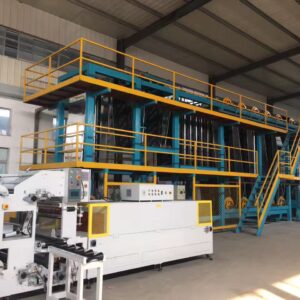
Beyond that, the bonding method matters. A thermally bonded web can re-soften at temperature, while a mechanically entangled web resists through fibre friction and geometry. How we build spunbond polyester mat from PET fibre walks through those production stages in more detail.
Three mat architectures, three different responses
Buyers often treat “polyester mat” as one product. In practice, the architecture drives the heat response far more than the gram weight does.
| Architecture | How it is built | Response to saturation heat | Best fit | What to watch |
|---|---|---|---|---|
| Spunbond (continuous filament) | Filaments spun, drawn, laid, and bonded into a web | Orientation relaxes under heat, so machine-direction shrinkage can run higher | General membrane production with stable process control | Machine-direction shrinkage; tension spikes at the bath entry |
| Needle-punched staple | Staple fibres carded, cross-lapped, and mechanically entangled | Fibre entanglement resists movement, so shrinkage tends to spread more evenly across directions | Lines that need balanced MD/CD behaviour | Bulk and thickness change after saturation |
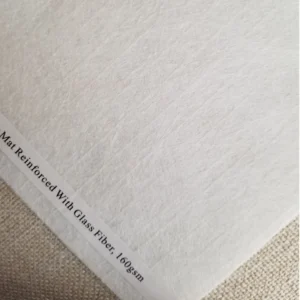
| Reinforced (scrim or mesh reinforced) | A base web carries a reinforcing yarn or mesh structure | The reinforcement constrains movement, so the web holds dimensions better | Thin membranes, high line speeds, tight width tolerance | Higher fabric cost; confirm adhesion at the interface |
On the other hand, architecture alone does not decide the outcome. Fibre fineness, bonding temperature, and calendering all shift the result within any one of these three groups. Test the specific construction you plan to buy.
What shrinkage does to your line
When a carrier shrinks more than your process tolerates, the symptoms rarely announce themselves as “shrinkage.” They appear as production problems:
- Ripples and wrinkles after the bath. Machine-direction contraction releases into the web as the sheet leaves the nip, and the wrinkles travel downstream.
- Width loss and edge trim waste. Cross-direction contraction narrows the sheet, and your slitting station cuts away the difference.
- Tension spikes at the unwinder. A shrinking web pulls against the brake, which drives the tension reading up and can trigger a break.
- Thickness variation across the width. Uneven shrinkage produces uneven compound pickup, so the sheet leaves the line with a thickness profile you cannot sell against a tight tolerance.
- Curl and poor winding. Contraction during the cooling stage bends the sheet and creates a soft or telescoped roll.
- Adhesion faults. A web that moves during saturation can trap voids at the interface, and those voids survive into the finished membrane.
This overview of common polyester mat defects connects several of these symptoms to their root causes in the fabric and in the process.
How to run a shrinkage test that tells the truth
You can characterise shrinkage with an oven, a steel rule, and a repeatable procedure. Work through the steps below, and record every condition alongside the result.
| Step | Action | Record |
|---|---|---|
| 1. Sample | Cut strips from the middle of the roll in both machine and cross direction | Roll number, position, direction |
| 2. Condition | Bring samples to a stable state in a controlled room | Conditioning time and conditions |
| 3. Mark | Mark a gauge length on each strip before exposure | Original length |
| 4. Expose | Place samples in an oven at your saturation temperature for your actual dwell time | Temperature, dwell time, restraint condition |
| 5. Cool | Cool samples under a fixed protocol | Cooling method and duration |
| 6. Measure | Measure the gauge length again | Final length |
| 7. Calculate | Express the change as a percentage of the original length | MD and CD results with replicates |
Two decisions shape the result more than any other. The first is temperature: test at the temperature your line actually runs, not at a comfortable figure from a datasheet. The second is restraint. An unrestrained test answers “what does this fabric want to do?”, while a test under production tension answers “what does it do on my line?” Run both, because they answer different questions.
For method references, ASTM D2732 covers unrestrained linear thermal shrinkage for film and sheeting of 0.76 mm or less, and its scope note points to ISO 11501, which addresses the same subject with different technical content. Neither standard targets nonwoven carrier fabric directly, so treat them as method templates. For nonwoven-specific procedures, the industry maintains harmonised test methods: EDANA publishes the Nonwovens Standard Procedures jointly with INDA, and INDA’s overview of nonwoven fabrics explains the structures those methods describe.
Three testing mistakes that hide the problem
Testing below your process temperature. A shrinkage test at a lower temperature flatters every fabric. Therefore a supplier who reports a single comfortable number has told you little about your bath.
Testing unrestrained only. Your line runs the web under tension, and tension changes the outcome in both magnitude and direction.
Reporting one average. Shrinkage varies along a roll and between rolls. Ask for the spread across samples and across batches, not only the mean.
Beyond those three, watch for the sample that came from a roll edge, and for the test that skipped the cooling stage. Both make the fabric look steadier than it is.
What to ask your supplier
Put these items in writing, and treat the answers as part of the offer.
| Question | Why you need the answer |
|---|---|
| Shrinkage at our saturation temperature, MD and CD | The number that predicts performance on your line |
| Shrinkage under production tension as well as unrestrained | Shows how the web behaves inside your bath |
| Dwell time used in the test | Temperature without dwell hides the time dependence |
| Typical range and batch-to-batch variation | Tells you whether you can hold a thickness tolerance |
| Construction details: bonding method, fibre fineness, reinforcement | Explains the mechanism behind the number |
| Retention of a reference sample per batch | Gives you a baseline when a dispute arises |
A supplier who answers all six has a process worth talking about. This guide to testing polyester mat quality before purchase extends that checklist into the other quality parameters.
Process levers when shrinkage runs high
Fabric choice is one control. Your line offers several others, and they cost less to change.
- Reduce dwell time at temperature where the membrane still saturates fully.
- Level the temperature across the width. A hot streak on one side shrinks that side faster and bends the sheet.
- Control the tension profile from unwinder to bath entry, so the web enters flat and stays flat.
- Ramp the pre-heat gently instead of shocking the web at the bath.
- Manage the cooling stage, because a fast, uneven quench locks in the distortion that heat created.
- Move up to a reinforced construction when the specification leaves no room for adjustment.
The economics of that last option deserve their own calculation, and this payback analysis for reinforced versus standard spunbond mat works through the trade-off. Meanwhile, remember that dimensional stability also protects service life downstream: carrier fabric quality shapes membrane lifespan more than the bitumen does.
FAQ
Why does a polyester mat shrink in hot bitumen? Polyester is a thermoplastic, and fibre production locks oriented polymer chains and internal stress into the material. Heat releases that stress, the fibres relax, and the web contracts. ASTM D2732 describes the same mechanism for oriented plastic film and sheeting.
How much shrinkage is acceptable in a carrier fabric? Acceptable depends on your line rather than on a universal figure. Define the limit from your own tolerance for wrinkling, width loss, and thickness variation, then ask each supplier to state their capability against that limit at your temperature and dwell time.
Does a heavier polyester mat shrink more? Not automatically. Gram weight influences how much material can move, yet orientation, bonding method, and fibre fineness usually decide the outcome. Two mats at 140 g can behave differently, so test the construction rather than the weight.
Why do reinforced polyester mats shrink less? The reinforcing yarn or mesh structure constrains movement inside the web, so the fabric holds its dimensions as the polymer relaxes. That constraint explains the higher price, and it also explains why reinforced mat suits thin membranes and tight width tolerances.
Should I test shrinkage unrestrained or under tension? Run both. An unrestrained test characterises the material, and a test under production tension predicts your line. When the two results diverge sharply, expect trouble at the bath entry.
Is 180 °C the right test temperature? Only if your line runs there. The figure appears often in process discussions and equipment specifications, so it makes a useful common reference point. Check your actual saturation set point first, then test at that temperature with your real dwell time. Get the fundamentals right first by reviewing how to spec a polyester mat alongside your shrinkage protocol.
Next step
Take one roll from your current supplier and one alternative roll. Run the protocol above at your saturation temperature, in both directions, restrained and unrestrained. Once you hold the four numbers, you can predict wrinkling and width loss before they reach the winder.
Guanlong Waterproof has manufactured spunbond and reinforced polyester mat for membrane producers since 2005, including reinforced spunbond grades built for demanding saturation conditions. Send us your membrane type, line speed, and saturation temperature, and we will share shrinkage data for the grades that fit your process.