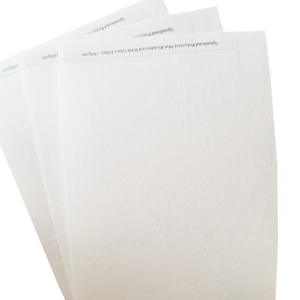
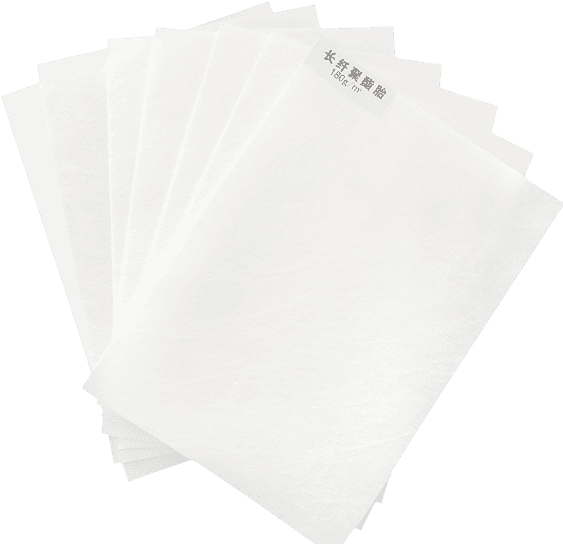
When a waterproofing membrane fails, most people blame the coating. In reality, the real story usually starts earlier — with the carrier fabric hidden inside the roll. For modified bitumen membranes, that carrier is often a spunbond polyester mat, a nonwoven reinforcement built from continuous PET filaments. Understanding how this material travels from polymer chip to finished roll helps buyers judge quality before they order, compare supplier claims, and avoid costly surprises on the production line. This guide walks through each manufacturing step and explains why every stage matters.
Step 1: Start with the Right PET Raw Material
Every roll starts with raw material selection. Most manufacturers begin with super-strength polyester chips (PET), because this polymer delivers the tensile performance that membrane producers rely on. Some suppliers blend recycled PET to cut costs, yet the blend ratio directly affects elongation, heat resistance and batch consistency. Guanlong, for example, selects high-grade chips to keep the fiber base uniform from batch to batch. At this stage, buyers should ask one simple question: what raw material grade does the factory use, and how does the QC team verify it?
Step 2: Melt and Extrude the Polymer
Next, the chips enter a drying and melting system. The extruder heats the polymer to a controlled temperature, then pushes the molten material through filters that remove impurities. Temperature control here decides fiber uniformity. If the melt fluctuates, the filaments become uneven, and the finished mat develops weak spots under tension. Therefore, a reliable production line runs continuous monitoring rather than periodic spot checks.
Step 3: Spin Continuous Filaments
After melting, the polymer passes through a spinneret — a plate packed with hundreds of tiny holes. Each hole forms one continuous filament as the polymer emerges and cools. High-speed air then draws the filaments down to the target diameter, typically from a few microns to tens of microns. Thinner, evenly drawn filaments produce a smoother and stronger spunbond polyester mat with excellent bitumen absorption. This step also explains why two mats with the same gram weight can still perform very differently — a point we cover in detail in our guide to 120g, 140g and 160g polyester mat gram weights. The same physics applies across the nonwoven industry, as the Wikipedia overview of nonwoven fabrics explains.
Step 4: Form the Web
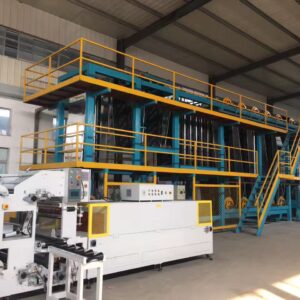
The drawn filaments then fall onto a moving conveyor belt, where they form a loose, uniform web. Belt speed and air flow control the basis weight — 120 g/m², 140 g/m² or 160 g/m², for instance. A stable web means stable tensile strength across the full roll width. In fact, the machine-direction (MD) and cross-direction (CD) values on a typical spec sheet — such as ≥230/200 N/5cm — depend heavily on how evenly the line lays this web. At the same time, web uniformity prepares the mat for smooth bitumen saturation later.
Step 5: Bond the Fibers
Once the web reaches the required thickness, the bonding step locks the fibers together. In spunbond production, heated rollers apply pressure and temperature so the polyester filaments fuse at their contact points. This thermal bonding gives the mat its dimensional stability and prevents delamination during bitumen coating. As a result, the finished carrier can survive the heat and tension of a membrane production line without stretching out of shape. Buyers can compare this mechanism with alternative carriers in our guide to spunbond vs. reinforced spunbond polyester mat.
Step 6: Wind, Slit and Inspect
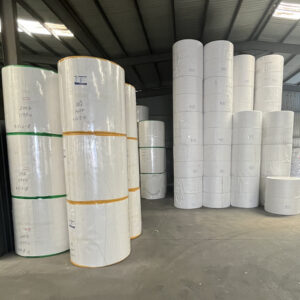
Finally, the bonded web cools, winds onto rolls, and moves through quality checks. Technicians measure gram weight, tensile strength, elongation and heat resistance against the agreed specification, following test methods such as those published by ASTM International. After that, the line slits the roll to the required width — typically 1.0 to 1.2 meters, though customization is common — and packs the goods for export. Consistent inspection at this stage protects both the supplier and the membrane producer downstream. For a closer look at the finished range, browse our polyester mat product category.
From Carrier Fabric to Finished Membrane
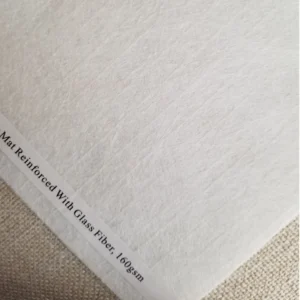
Once the spunbond polyester mat reaches a membrane factory, it enters the coating process, where SBS or APP modified bitumen saturates the fabric. The mat’s open structure absorbs bitumen efficiently, while its elongation lets the finished membrane flex with building movement. For this reason, the carrier fabric largely decides how a membrane performs over 20 to 50 years of service. You can explore this relationship in our article on how polyester mat strength translates into tensile, elongation and puncture performance. Likewise, our gram weight guide explains what each specification delivers in real production.
Why Process Control Matters When You Source
Many buyers compare price per square meter, but the real cost difference sits in process control. A factory that monitors melt temperature, web uniformity and bonding pressure delivers consistent rolls; one that skips these checks ships unpredictable lots. When you source from a specialist like Weifang Guanlong Waterproof Materials Co., Ltd., you gain nearly two decades of experience in waterproof base materials, from spunbond polyester mat and compound base mat to complete production lines. Ask for test reports, request samples, and visit the production line if you can. For specific specifications or a quotation, contact our team directly.
FAQ
Q1: What is a spunbond polyester mat?
A spunbond polyester mat is a nonwoven reinforcement fabric built from continuous PET filaments. Producers bond these filaments together with heat and pressure, creating a carrier that gives waterproofing membranes tensile strength, elongation and dimensional stability.
Q2: What raw materials go into a spunbond polyester mat?
The main raw material is PET (polyester) chips. High-quality grades deliver better tensile strength, heat resistance and consistency, while recycled PET can lower cost with some trade-offs in performance. The manufacturing process itself — melting, spinning, web forming and thermal bonding — decides the final quality.
Q3: Why do membrane producers use polyester mat instead of other carriers?
Polyester mat combines high tensile strength with excellent elongation and bitumen compatibility. It also withstands the heat of SBS/APP coating lines. These properties make it the preferred carrier for modified bitumen waterproofing membranes in most markets.
Q4: Which gram weight should I choose: 120g, 140g or 160g?
The choice depends on the membrane type and the performance target. Lighter mats such as 120g suit economical products, while heavier options provide more reinforcement for demanding projects. Review the application requirements, or ask the supplier for material selection guidance.
Q5: How can I check polyester mat quality before placing an order?
Request a test report and sample rolls first. Check gram weight, tensile strength (MD/CD), elongation, heat resistance and dimensional stability against your specification. A reliable supplier will share this data openly and support a trial order.