If you produce or specify modified bitumen membranes, you already know the two dominant polymer systems: SBS (styrene-butadiene-styrene) and APP (atactic polypropylene). Both are called “modified bitumen”, yet they behave very differently on the roof — and the carrier fabric hidden inside each sheet has to be matched to the polymer, not chosen by habit.
This guide compares SBS and APP systems and explains which carrier fabric fits each one. However, before comparing prices, it helps to understand why the polymer and the reinforcement are inseparable partners. As we showed in Why Carrier Fabric Quality Determines Membrane Lifespan, the base mat quietly decides how long a membrane survives — the bitumen just gets the credit.
SBS vs APP: What Is Actually Different?
SBS is an elastomeric (rubber-like) modifier. It gives bitumen high flexibility and elasticity at low temperatures, which is why SBS membranes dominate cold climates and dynamic structures.
APP is a plastomeric (plastic-like) modifier. It raises the softening point and heat resistance of the sheet, making APP membranes the preferred choice for hot climates and high-sunlight exposure, at the cost of reduced low-temperature flexibility.
| Property | SBS membrane | APP membrane |
|---|---|---|
| Modifier type | Elastomer (rubber-like) | Plastomer (plastic-like) |
| Low-temperature flexibility | Excellent | Limited |
| Heat resistance | Good | Excellent |
| Typical climate | Cold / temperate | Hot / tropical |
| Typical reinforcement | Polyester mat | Polyester mat, sometimes glass fiber |
For a deeper look at how these two systems are specified in the field, the industry guidance on specifying modified bitumen sheet products from Professional Roofing is a useful reference. In addition, formal product specifications split the two families clearly: SBS composite-reinforced sheets are covered by ASTM D6162, while APP sheets with polyester reinforcement are covered by ASTM D6222.
Why the Carrier Fabric Has to Match the Polymer
The carrier fabric (also called the reinforcement or base mat) carries the membrane’s tensile load, limits elongation, and gives the sheet dimensional stability during coating and on the roof. Therefore, the fabric’s properties must complement the polymer’s behaviour:
- An SBS sheet needs a carrier fabric with balanced tensile strength and good elongation, so the membrane can flex and recover without tearing the reinforcement.
- An APP sheet runs at higher coating and service temperatures, so the fabric must hold its dimensions and tensile performance under sustained heat.
- In both cases, the fabric must wet out properly with the modified bitumen; poor adhesion between fabric and coating causes delamination later.
Consequently, selecting a carrier fabric is not a one-size-fits-all decision — it is a system engineering choice. The comparison we published earlier, Compound Base Mat vs. Polyester Mat: Which Carrier Fabric Is Right for Your Bitumen Membrane?, already covers fabric family selection in depth.
Polyester Mat: The Default Carrier Fabric for Both Systems
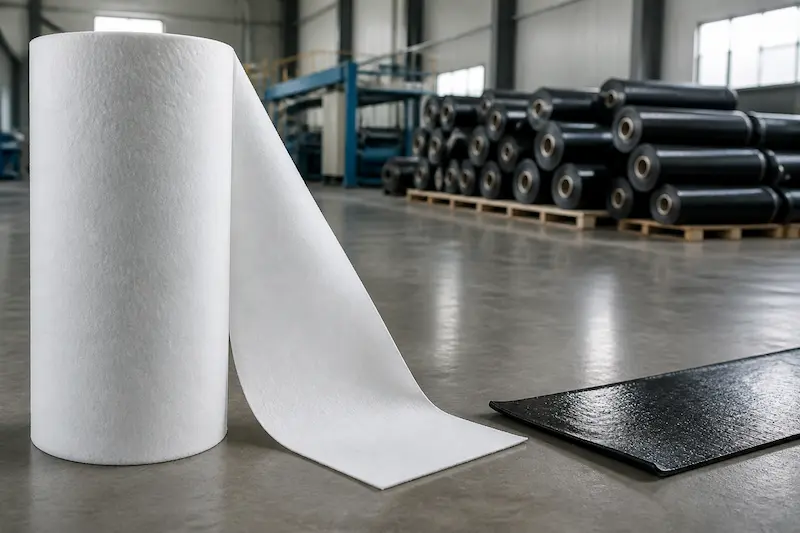
For the vast majority of SBS and APP production, a polyester mat — specifically a spunbond polyester mat — is the default choice, and for good reason:
- High tensile strength per gram — polyester fibres deliver more strength at lower GSM than most alternatives, lowering material cost per square metre.
- Controlled elongation — typical spunbond polyester mat offers 20–40% elongation at break, which matches SBS’s need for flexibility.
- Heat stability — quality polyester mat keeps its dimensions at coating temperatures, which suits APP’s hotter process window.
- Excellent bitumen wet-out — the fibre structure absorbs and bonds with modified bitumen, preventing delamination.
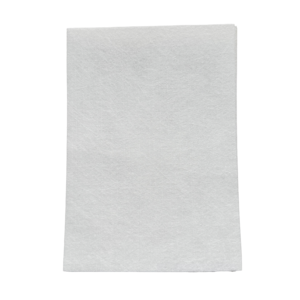
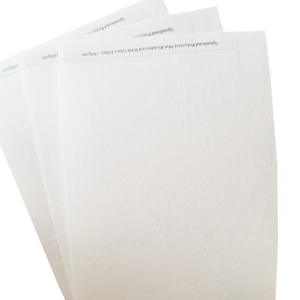
Two grades matter most in practice. The standard spunbond polyester mat covers most SBS and APP formulations, while the reinforced spunbond polyester mat — reinforced with an embedded scrim — is specified when the membrane must carry higher loads, such as in mechanically fastened systems.
When a Compound Base Mat Makes Sense
Not every membrane wants a pure polyester mat. A compound base mat combines polyester or cotton fibres with a woven grid (commonly Leno weave), adding dimensional stability and tear resistance at a competitive cost.
- For APP sheets in hot climates, where thermal expansion is the main enemy, a grid-reinforced compound base mat improves dimensional stability without adding excessive cost.
- For economy SBS lines, a compound base mat can lower material cost while still meeting basic tensile requirements.
To understand the structure before choosing, read our guide on what a compound base mat is, from 4×4 to 8×8 mesh counts, or browse the Leno compound base mat product page for the grid options.
Fiberglass and Composite Reinforcement
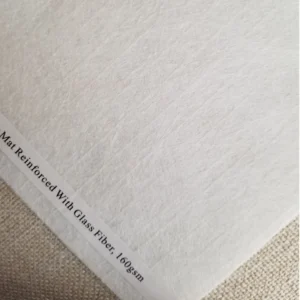
For demanding applications, the carrier fabric is not limited to polyester alone. ASTM D6162, for instance, covers SBS sheets reinforced with a combination of polyester fabric and glass fiber — the glass fiber adds stiffness and dimensional stability, while the polyester provides elongation and tear resistance.
In practice:
- Glass fiber mats suit high-heat APP applications where rigidity and low elongation are desired.
- Composite (polyester + glass) reinforcements balance the strengths of both, often used for premium SBS systems and torch-applied membranes.
- However, glass fiber alone is brittle: it lacks the elongation and puncture resistance that polyester provides, which is why most composite sheets keep polyester as the dominant layer.
A Practical Selection Guide
Use this quick decision logic when you choose the carrier fabric for a new membrane recipe:
| Your situation | Recommended carrier fabric |
|---|---|
| Cold-climate SBS, standard performance | Spunbond polyester mat, 150–180 g/m² |
| SBS with high mechanical load | Reinforced spunbond polyester mat |
| Hot-climate APP, economy line | Compound base mat or standard polyester mat |
| APP requiring high dimensional stability | Glass fiber or composite reinforcement |
| Self-adhesive SBS underlayment | Polyester mat with tight thickness uniformity |
Finally, whichever carrier fabric you choose, verify it before it enters your line. Our article on common polyester mat defects lists the field checks that catch bad rolls early, and How Guanlong Controls Quality from Raw Fiber to Finished Roll explains the testing behind consistent rolls.
Get the Right Carrier Fabric for Your Recipe
Matching the carrier fabric to your SBS or APP system is the cheapest quality upgrade most membrane plants can make. For a recommendation based on your climate, formulation and line conditions, contact the Guanlong sales team — we can send samples and technical data for polyester mats, reinforced mats and compound base mats, so you can test before you commit.