Every bitumen waterproofing membrane relies on a hidden backbone: the base mat that carries the coating and absorbs mechanical stress. Among the many reinforcement options, the compound base mat stands out for its balance of strength, stability, and price. But what exactly is a compound base mat, what do the mesh counts 4×4 through 8×8 mean, and where should you use it? This guide answers all three questions in plain, practical terms.
What Is a Compound Base Mat?
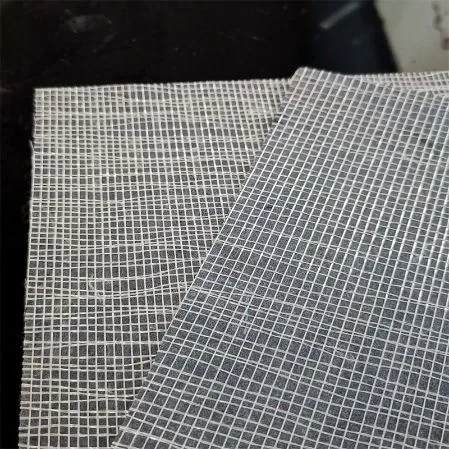
A compound base mat is a composite reinforcement fabric that combines a fiberglass leno scrim with polyester nonwoven layers. During production, the manufacturer feeds fiberglass mesh into the nonwoven web as it forms, then dries and finalizes the combined structure at high temperature. This compounding process fuses the two materials into one stable sheet.
The combination delivers what neither material achieves alone. Fiberglass supplies rigidity and dimensional stability, while the polyester nonwoven adds flexibility and strong bitumen absorption. Consequently, the finished mat resists shrinkage during coating, carries high tensile loads, and bonds reliably with SBS and APP modified bitumen.
The Structure of a Compound Base Mat
To understand the product, look at its three functional parts:
Fiberglass leno scrim. The scrim forms the structural core. Its leno weave locks the glass yarns in place, preventing slippage during coating and handling.
Polyester nonwoven layers. These layers encapsulate the scrim on both sides. They improve handling, cushion the glass fibers, and soak up bitumen evenly during saturation.
Thermal bonding. High-temperature drying and finalizing fix the layers together, so the mat keeps a smooth, uniform surface that promotes consistent coating.
In short, the mat combines a rigid core with flexible faces — a structure purpose-built for membrane production lines that run hot and fast.
Mesh Counts Explained: 4×4 to 8×8 (and Beyond)
The mesh count describes the density of the fiberglass scrim — how many glass yarns run in each direction per unit of width. A 4×4 compound base mat carries four yarns per unit in both directions; an 8×8 mat carries eight. The higher the count, the more glass in the structure.
4×4 compound base mat. The lightest standard configuration. Typical basis weight runs 150–200 g/m² with tensile strength of ≥450/400 N/5cm in machine and cross directions. It suits standard roofing membranes and general waterproofing. See the 4×4 product page for full specs.
5×5 and 6×6. Middle-ground options that balance strength and weight. Producers choose these grades when they need a bit more reinforcement than 4×4 without stepping up to the heavier scrims. Browse the 5×5 and 6×6 grades for details.
7×7 and 8×8. Dense scrims for demanding jobs. The 8×8 compound base mat typically weighs 130–180 g/m² and delivers ≥300/260 N/5cm, with enhanced tear resistance and dimensional stability for heavy civil applications. Check the 8×8 grade and the 7×7 option.
Leno 8×8 and 9×9. For maximum stability, manufacturers also offer leno-weave grades such as the 8×8 compound base mat at 140g and the 9×9 grade at 180g.
A simple rule guides the choice: choose a lower mesh count for cost-efficient standard membranes, and a higher count when tear resistance and stability take priority.
Where Is a Compound Base Mat Used?
SBS and APP modified bitumen membranes. The mat serves as the reinforcement layer in both polymer-modified systems, providing the tensile backbone under the bitumen coating.
Roofing systems. From residential flat roofs to commercial low-slope decks, compound-base membranes deliver reliable, long-term waterproofing. NRCA offers extensive guidance on roof system design and installation.
Underground and foundation waterproofing. Below-grade walls and basements face constant hydrostatic pressure; the mat’s dimensional stability helps the membrane stay intact under load.
Tunnels and bridges. Heavy civil structures demand tear resistance and puncture protection. Compound base mats meet these requirements while keeping production costs competitive.
Compound felt and multi-layer membranes. When producers build multi-ply systems, the mat provides a stable base layer that improves interlayer adhesion.
In each application, the principle stays the same: the mat transfers stress, keeps the membrane flat, and makes the coating layer do its one job — stopping water. To understand why carrier fabric quality drives membrane lifespan, see our article on how mat strength translates into membrane performance. You can also read about bituminous waterproofing systems in general on Wikipedia.
How to Choose the Right Mesh Count for Your Line
Start with the membrane’s required tensile performance, then work backward to the mesh count. First, confirm the tensile and tear values your customers or local standards demand. Second, match those values to a grade — 4×4 for standard duty, 6×6 for balanced duty, 8×8 or 9×9 for heavy duty. Third, verify the basis weight against your coating formulation, because heavier mats absorb more bitumen and raise material cost.
Run a trial on your own line before committing to volume. Test coating uniformity, roll flatness, and shrinkage with the actual grade you plan to buy. Our guide to testing polyester mat quality explains the checks that apply to any carrier fabric, and our gram weight guide shows how basis weight changes performance and cost.
Sourcing Compound Base Mat from a Specialist
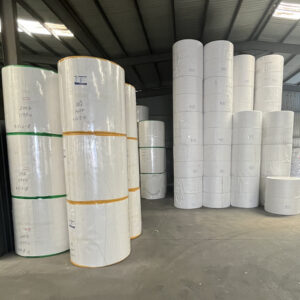
The compound base mat performs only as well as the factory that makes it. Weifang Guanlong Waterproof Material Co., Ltd. has manufactured waterproof membrane base materials since 2005, operating modern compound base mat production lines in Shandong, China. The company produces the full 4×4 to 8×8 range, customizes basis weight, width, and roll length, and exports to customers across Asia, the Middle East, and Europe.
Browse the complete compound base mat category to compare grades, or read about the company on the About Us page. If you produce bitumen membranes and want to test a grade on your line, contact the Guanlong team for samples and technical guidance.
Frequently Asked Questions
1. What do the numbers 4×4, 6×6, and 8×8 mean in a compound base mat?
They describe the density of the fiberglass scrim — how many glass yarns run in each direction per unit of width. Higher counts mean more glass fiber, higher tear resistance, and greater dimensional stability.
2. What is the difference between a compound base mat and a polyester mat?
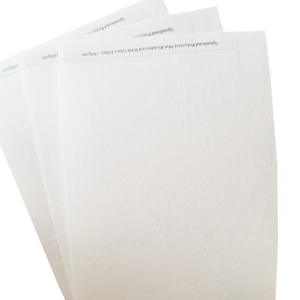
A compound base mat combines a fiberglass scrim with polyester nonwoven layers, offering higher tensile strength and stability. A polyester mat consists only of PET filaments, providing more flexibility at lower cost. You can compare both options in the polyester mat category.
3. What tensile strength can I expect from a compound base mat?
Typical grades deliver 300–450 N/5cm depending on mesh count. For example, the 4×4 grade offers ≥450/400 N/5cm, while the 8×8 grade offers ≥300/260 N/5cm.
4. Can Guanlong customize the weight and width?
Yes. Guanlong adjusts basis weight, width, and roll length to match each customer’s membrane formulation and production line.
5. Which mesh count works best for APP-modified bitumen membranes?
Both 4×4 and 8×8 grades work with APP systems. Choose 4×4 for cost-efficient standard membranes and 8×8 for projects that demand higher tear resistance and stability.
6. How do I request samples of compound base mat?
Contact the Guanlong team through the website form or WhatsApp, describe your membrane formulation and line speed, and the team will recommend a grade and arrange samples.
Conclusion
A compound base mat combines fiberglass scrim and polyester nonwoven into a reinforcement that keeps SBS and APP membranes flat, strong, and dimensionally stable. The mesh count — 4×4 through 8×8 — lets you tune that performance to your product and budget. Choose the grade that matches your tensile requirements, verify it with a trial on your line, and source from a manufacturer with the production capability to deliver consistent quality, roll after roll.