Ask a membrane producer which specification caused last month’s worst stoppage, and the answer rarely names gram weight or tensile strength. It names a roll that ran 8 mm narrow, a splice that opened at 30 m/min, or a roll length that forced an extra changeover in the middle of a campaign.
Width, length, and splice tolerances look like administrative details on a purchase order. In practice they govern how often your line stops, how much carrier you pay for, and how much edge trim you throw away. This article covers what to write into the specification, how to check a delivery before it reaches the unwinder, and how to turn each item into a number your management team recognises.
Why roll tolerances slip through the RFQ
Most buyers negotiate three things: price, gram weight, and delivery date. Those three numbers fit neatly into a comparison table, so they attract attention.
Roll width tolerance resists that treatment. A supplier who offers ±3 mm and a supplier who offers ±15 mm may quote the same price per square metre, because the tolerance costs the supplier production time rather than raw material. Consequently the difference stays invisible until the line tells you about it.
Meanwhile, the costs land in places your quotation comparison never reaches. Trim waste shows up in the material balance. Changeovers show up in the shift report. A web break shows up as lost hours and scrapped membrane. Therefore a purchase order that fixes only price and gram weight leaves the expensive variables unmanaged.
The four roll specs that decide line efficiency
These four items drive almost all roll-related downtime. Treat them as one specification block rather than four separate line items.
1. Width and its tolerance. Width sets your trim allowance. When a roll arrives narrower than planned, the sheet cannot reach finished width, and you lose a full roll or run it at reduced width.
2. Roll length and roll weight. Roll length decides how many changeovers a shift contains. Roll weight decides whether your handling equipment copes and whether operators can lift the core safely.
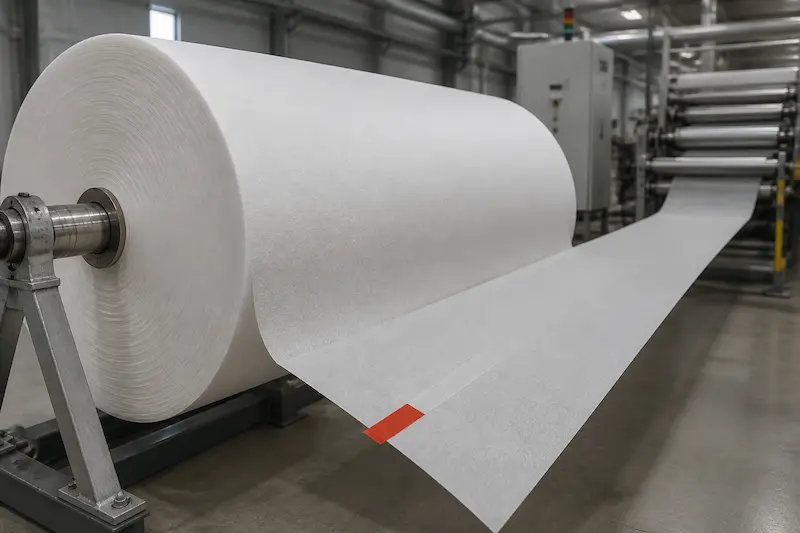
3. Splice count and splice quality. Every splice marks a potential break point. Count, strength, and marking all matter, and a single weak splice can cost more than a year of width variance.
4. Core diameter and winding quality. The core fits your mandrel. Winding tension decides whether the roll unwinds flat or telescopes into a wobbling mass.
The full polyester mat specification guide covers the material properties that sit alongside these four items. Downstream, the finished membrane spends decades on a roof, and the ARMA technical bulletins on modified bitumen roofing together with the NRCA technical library document how system performance depends on material consistency from the first roll to the last.
How a few millimetres turn into money
The arithmetic below uses illustrative inputs so you can follow the method. Substitute your own working width, line speed, and prices before you act on the result.
Width tolerance converts into purchased width
Suppose your membrane needs 1,015 mm of usable carrier width, and you must guarantee that figure against the worst roll in the delivery. You therefore order nominal width plus the tolerance.
| Supplier tolerance | Nominal width you must order | Extra width versus a ±3 mm supply |
|---|---|---|
| ±3 mm | 1,018 mm | — |
| ±15 mm | 1,030 mm | 12 mm per running metre |
That 12 mm difference equals 0.012 m² of extra carrier per running metre. At 2,000,000 running metres a year, the loose tolerance forces you to buy roughly 24,000 m² of carrier you never needed. The supplier saves cost on sorting and trimming; you absorb it in the material balance.
Roll length converts into changeovers
Now look at roll length. Assume the line runs at 25 m/min and each changeover stops the line for 4 minutes.
| Roll length | Running time per roll | Rolls per 480-minute shift | Changeover minutes per shift |
|---|---|---|---|
| 2,000 m | 80 min | 6.0 | 24 min |
| 1,600 m | 64 min | 7.5 | 30 min |
The shorter roll adds 1.5 changeovers every shift, or 6 minutes of stopped line. Across three shifts and 300 working days, that grows to about 90 hours of lost running time per year — with no material benefit in return.
Splices convert into risk
A splice costs you a few seconds when it passes the bath cleanly. When it opens, it costs far more: a web break, a threaded restart, and membrane that fails inspection. Consequently the splice specification deserves more attention than its frequency suggests.
A roll specification sheet for your purchase order
Copy this block into your RFQ. Each row gives the supplier something measurable to accept or decline.
| Specification item | Suggested wording | Why it matters |
|---|---|---|
| Nominal width | e.g. 1,020 mm | Sets the trim allowance |
| Width tolerance | Maximum deviation from nominal, measured anywhere in the roll | Direct driver of purchased width |
| Roll length | Metres per roll, with a maximum deviation | Direct driver of changeover count |
| Roll weight | Maximum weight per roll | Handling and mandrel limits |
| Core diameter | Inside diameter with tolerance, plus minimum crush strength | Mandrel fit and unwinding stability |
| Splice count | Maximum splices per roll, and maximum per 1,000 m | Break risk per roll |
| Splice position | No splice within the first and last metres of the roll | Protects start-up and run-out |
| Splice strength | Minimum retained strength at the splice | Prevents opening under line tension |
| Splice marking | Tape flag or marker visible to the operator | Lets the crew slow the line in advance |
| Width measurement points | Three positions per roll, recorded on the label | Makes verification possible |
| Packaging and moisture protection | Wrapping specification and moisture limit at dispatch | Protects the roll in transit and storage |
A specification only holds when someone records the measurement. The ISO 9000 family of quality management standards sets out the framework behind that discipline, and ANSI’s listing for ASTM D5147/D5147M covers sampling and testing of modified bituminous sheet material — useful when you define how finished rolls get sampled. Our own quality control process from raw fibre to finished roll shows how those measurements get recorded at the plant.
Why two suppliers quote differently on the same tolerance
A tight tolerance costs the supplier real production effort, and understanding that effort strengthens your negotiation. Ask what happens behind each promise.
| Tolerance promise | What it demands from the supplier |
|---|---|
| ±15 mm width | Slitting accuracy that clears the target on average |
| ±3 mm width | Width measurement on every roll, disciplined edge trim, and sorting of off-spec rolls |
| Long roll length, capped splices | Longer unwinding runs and fewer roll changes on the winding line |
| Capped splice count per 1,000 m | Tighter control of the forming and bonding stages |
| Marked, strength-tested splices | An inspection step and a record per roll |
| Declared weight per roll | Accurate winding and a scale at the packing station |
Consequently a supplier who accepts every tight figure has invested in measurement, not only in machinery. That distinction matters more than a marginal price difference, because tolerance capability comes from process discipline rather than from goodwill.
Specifying splices so they never surprise you
A splice is a manufacturing necessity, not a defect. However, an undeclared splice behaves like a defect, because your crew meets it without warning.
Write four things into the specification. First, cap the count per roll and per 1,000 m. Second, exclude the first and last metres, where a splice interferes with start-up and run-out. Third, require a minimum retained strength so the splice survives bath tension. Fourth, require a visible flag, because a marked splice lets the operator reduce speed for a few seconds instead of threading the line for twenty minutes.
Beyond those four, ask how the supplier declares splices on the packing list. A supplier who counts them on the label gives you a verifiable record, and that record supports a claim if the roll underperforms.
Incoming inspection: fifteen minutes at goods-in
Most plants inspect carrier fabric by eye. A short, structured check catches the failures that cost the most, and it needs nothing beyond a tape measure, a scale, and a torch.
| Check | Method | Reject if |
|---|---|---|
| Width | Measure at three points: outer end, middle, inner end | Any reading falls outside tolerance |
| Roll weight | Weigh one roll per delivery | Weight deviates beyond the agreed band |
| Splice count | Compare the label against the packing list, then feel for taped joints | Count exceeds the cap, or a splice sits in an excluded zone |
| Splice quality | Inspect a sample splice under tension by hand | The joint separates under light pull |
| Core | Measure inside diameter; check for crush deformation | Core will not seat cleanly on the mandrel |
| Winding | Sight along the roll for telescoping or a soft end | The roll face steps or bulges |
| Packaging and moisture | Check wrapping integrity and any condensation | Wrapping is torn or the roll feels damp |
| Tail | Confirm the leading end is taped and clean | The tail is loose, dirty, or damaged |
This quality test guide for polyester mat extends the list to strength, gram weight, and absorption. Meanwhile, this review of common polyester mat defects links the symptoms back to their causes in the fabric.
Three mistakes that keep the downtime coming
Accepting “standard roll length” without a calculation. Suppliers offer convenient round figures, and those figures may not match your changeover tolerance. Run the shift arithmetic above before you agree.
Counting splices on the outer layers only. Operators meet the outer layers first, so a superficial check passes. Ask for the declared count, then verify a full roll.
Ignoring core diameter and winding hardness. A core that runs 1 mm oversize creates intermittent slip, and a soft-wound roll feeds unevenly. Both produce tension variation that operators blame on the tension controller.
On the other hand, an experienced crew often compensates for these problems without reporting them. Therefore ask your shift supervisors which supplier causes the most “quirks.” Their list usually matches the specification gaps.
FAQ
What roll width tolerance should I specify for carrier fabric? Start from the width your membrane needs, then add the tightest tolerance your supplier can hold with a documented measurement routine. A tighter tolerance lets you order less nominal width, so the tolerance pays for itself in reduced trim waste.
How does roll width tolerance increase my material cost? You must guarantee usable width against the narrowest roll in the delivery, so you order nominal width plus the tolerance band. A wider band therefore forces you to buy more carrier per running metre, and that surplus leaves the plant as edge trim.
How do I choose the right roll length? Convert roll length into running minutes at your line speed, then compare that figure with your changeover time and campaign length. Roll length that matches a whole campaign or a whole shift reduces stoppages without extra cost.
How many splices per roll should I accept? Set the cap from your break risk rather than from industry habit. A workable approach combines a maximum per roll, a maximum per 1,000 m, a minimum retained splice strength, and an exclusion zone at both ends of the roll.
Do splices really cause web breaks? They can. A splice that carries less strength than the surrounding fabric becomes the weakest point in the web, and line tension concentrates there. Marked splices let operators reduce speed briefly, which removes most of the risk.
Why does core diameter matter so much? The core fits your unwinder mandrel, so a variance in inside diameter causes slip and uneven tension. Core crush strength matters as well, because a deformed core makes the roll wobble and feeds the web off-centre.
Next step
Pull one delivery from your current supplier and run the fifteen-minute check above. Record width at three points, weigh a roll, count the declared splices, and measure a core. Then apply the two calculations in this article to your own line speed and order volume. Most plants find at least one item worth adding to their next specification.
Guanlong Waterproof produces spunbond and reinforced polyester mat on roll lengths and widths set to customer requirements, including standard spunbond grades and reinforced constructions for high-speed lines. Send us your working width, line speed, and changeover tolerance, and we will propose a roll specification that fits your process rather than our standard list.