
When it comes to waterproofing systems—especially bituminous membranes—spunbond polyester mats play a crucial role in delivering dimensional stability, tensile strength, and long-term durability. One of the key specifications that manufacturers, contractors, and project designers must consider is the weight of the polyester mat. Different weights offer different performance characteristics and are selected based on the requirements of the waterproofing application.
In this article, we’ll explore the common weights of spunbond polyester mats, how they are used, and what factors influence their selection.
Why Polyester Mat Weight Matters
The weight of a spunbond polyester mat (measured in grams per square meter, or gsm) directly affects:
-
Tensile strength
-
Tear resistance
-
Dimensional stability
-
Flexibility during application
-
Membrane thickness and durability
-
Cost of production and installation
Heavier mats generally contribute to stronger, thicker, and more robust waterproofing membranes, while lighter mats provide flexibility and cost efficiency.
Common Weights of Spunbond Polyester Mats in Waterproofing
While weights can vary depending on regional standards and manufacturers, the following are the most commonly used categories:
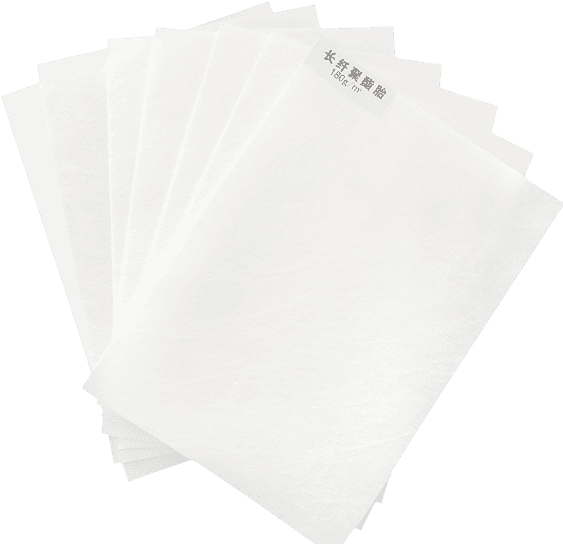
| Items | Weight | Moisture content |
|---|---|---|
| Spun bond Polyester mat | 140 | < 0.50% |
| 160 | < 0.50% | |
| 180 | < 0.50% | |
| 200 | < 0.50% |
1. Light-Weight Polyester Mats (90–160 gsm)
Typical range: 90 gsm, 110 gsm, 120 gsm, 140 gsm, 150–160 gsm
Applications:
-
Torch-on or self-adhesive bituminous membranes
-
Single-layer membranes used in residential or light commercial projects
-
Modified bitumen sheets where flexibility is a priority
Advantages:
-
High flexibility during installation
-
Lower production cost
-
Suitable for membranes where extreme tensile strength is not required
These lighter mats are often used in APP- and SBS-modified bitumen membranes where easy handling and rollability are important.
2. Medium-Weight Polyester Mats (180–250 gsm)
Typical range: 180 gsm, 200 gsm, 220 gsm, 250 gsm
Applications:
-
Multi-layer waterproofing systems
-
Commercial and industrial roofing membranes
-
Reinforcement layers requiring balanced strength and flexibility
Advantages:
-
Good balance between strength and flexibility
-
Suitable for environments with moderate mechanical stress
Medium-weight mats are widely used due to their versatility and are considered the industry standard for many waterproofing applications.
3. Heavy-Weight Polyester Mats (300–450 gsm)
Typical range: 300 gsm, 350 gsm, 400 gsm, 450 gsm
Applications:
-
Heavy-duty waterproofing membranes
-
High-traffic roofs or areas exposed to mechanical loads
-
Bridges, tunnels, underground structures
-
Premium membranes requiring superior dimensional stability
Advantages:
-
Excellent tensile strength and tear resistance
-
Enhances durability for long-term performance
-
Better resistance to thermal shock and movement
These mats are commonly used in infrastructure-level waterproofing where performance requirements are stringent.
4. Specialty High-Strength Polyester Mats (500 gsm and above)
Typical range: 500–600 gsm
Applications:
-
Ultra-heavy-duty waterproofing
-
Structural applications with extreme load conditions
-
Customized industrial membranes
These are less common and typically manufactured to meet specific project requirements.
How to Choose the Right Weight
When selecting the appropriate polyester mat weight, consider:
-
Project type – Residential, commercial, or industrial
-
Environmental conditions – Temperature cycles, moisture exposure
-
Mechanical load – Foot traffic, equipment, structural movement
-
Membrane type – SBS, APP, or self-adhesive bitumen
-
Durability needs – Expected service life and maintenance cycles
A product with the right polyester mat weight can significantly enhance the performance and longevity of the waterproofing system.
Conclusion
Spunbond polyester mats are essential reinforcement components in waterproofing membranes, and their weights vary widely to meet different performance needs. The most common weights range from 90 gsm to 450 gsm, with heavier mats offering higher strength and lighter mats providing better flexibility and cost efficiency.
Understanding these weight categories helps manufacturers, contractors, and engineers select the optimal material for durable, efficient, and long-lasting waterproofing systems.
If you need help choosing the right polyester mat weight for a specific project, feel free to ask!
Contact Us
Weifang Guanlong Waterproof Material Co., Ltd.Your reliable partner for high-quality materials and professional support.
📞 Phone/WhatsApp: +86 18263668883
🌐 Website: glwaterproof.com/product/
📧 Email: 15065670055@163.com