When waterproofing manufacturers order compound base mats, one specification trips up even experienced buyers: grid size. The numbers look deceptively simple — 4×4, 5×5, 6×6, 7×7, 8×8 — but each represents a fundamentally different reinforcement profile. Picking the wrong grid density sends ripple effects through your entire bitumen membrane production line, from coating uniformity to finished roll tensile strength.
This guide breaks down what each grid size means, what it does inside a modified bitumen membrane, and how to select the right one for your specific application — whether you produce APP membranes for high-temperature Middle Eastern roofing or SBS membranes for cold-climate basement waterproofing in Northern Europe.
What the Grid Number Actually Means
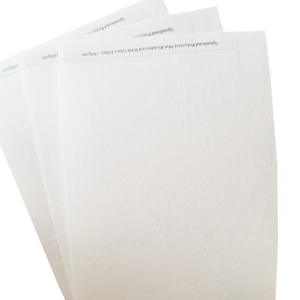
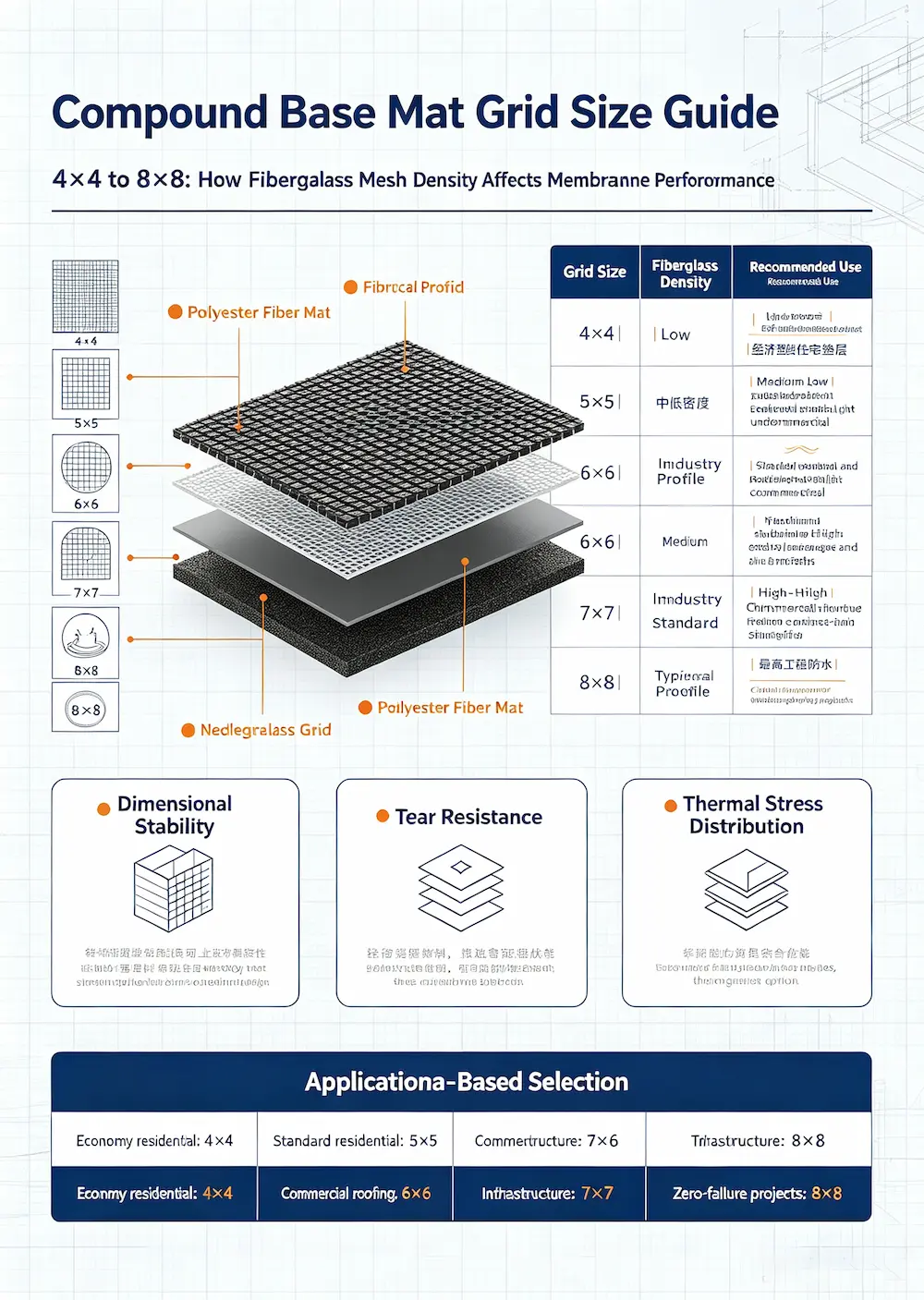
A compound base mat combines two layers: a fiberglass mesh (the “grid”) sandwiched between polyester fiber mats that get needle-punched together. The grid size — for example, “6×6” — refers to the number of fiberglass yarns per inch in both the warp (machine direction) and weft (cross direction).
| Grid Size | Yarns per Inch | Mesh Opening | Character |
|---|---|---|---|
| 4×4 | 4 × 4 | Largest | High dimensional stability, lower weight |
| 5×5 | 5 × 5 | Large | Balanced cost-performance ratio |
| 6×6 | 6 × 6 | Medium | Industry standard for general waterproofing |
| 7×7 | 7 × 7 | Small | Enhanced tear resistance |
| 8×8 | 8 × 8 | Smallest | Maximum strength, higher density |
A finer mesh (higher number) means more fiberglass per unit area — this increases tensile strength and dimensional stability but also adds weight and cost. A coarser mesh (lower number) keeps the mat lighter and more flexible but sacrifices some structural rigidity.
Grid Size vs. Membrane Performance: The Mechanics
The fiberglass grid inside a compound base mat serves three functions:
-
Dimensional stability — The grid resists elongation and shrinkage when the membrane passes through the hot bitumen bath (typically 160–190°C). Without sufficient grid density, the mat stretches during coating, creating uneven thickness in the finished roll.
-
Tear resistance — When installers handle the membrane on a roof, they pull, cut, and reposition it. The grid prevents the mat from tearing along the machine direction — a common failure mode with pure polyester mats.
-
Thermal load distribution — On a roof exposed to direct sunlight, surface temperatures can swing from -20°C to +80°C within 24 hours. The grid distributes thermal expansion stress evenly across the membrane, preventing localized cracking.
The grid size directly controls how well each of these functions performs.
| Grid Size | Dimensional Stability | Tear Resistance | Flexibility | Typical GSM Range |
|---|---|---|---|---|
| 4×4 | Moderate | Excellent | 90–110 gsm | |
| 5×5 | Good | Moderate | Good | 100–130 gsm |
| 6×6 | Very Good | Good | Good | 110–140 gsm |
| 7×7 | Excellent | High | Moderate | 130–160 gsm |
| 8×8 | Maximum | Highest | Lower | 150–180+ gsm |
Application-Based Selection Guide
4×4 Compound Base Mat: Lightweight Residential & Economy Membranes
Best for: Budget-conscious residential roofing, temporary waterproofing layers, underlayment membranes.
A 4×4 grid delivers just enough fiberglass reinforcement to keep the mat intact during bitumen coating. The low grid density means the mat weighs less, which lowers raw material cost per square meter. For manufacturers targeting the economy segment — single-layer residential roofing membranes, shed waterproofing, or temporary site protection — 4×4 provides adequate performance without over-engineering.
Limitations: Do not use 4×4 mats for multi-layer systems, heavy-traffic roofs, or any application where the membrane faces significant thermal cycling. The low yarn count provides limited resistance against shrinkage during coating, so process temperature control becomes critical.
5×5 Compound Base Mat: The Cost-Performance Sweet Spot
Best for: General residential and light commercial waterproofing, standard SBS membranes.
The 5×5 grid hits a pragmatic balance — noticeably better stability than 4×4 without the cost jump that comes with 6×6. Many manufacturers use 5×5 as their standard specification for mid-range SBS membranes destined for residential basements, bathrooms, and small commercial flat roofs.
This specification works particularly well for manufacturers serving markets where price sensitivity outweighs extreme weather requirements — Southeast Asia, parts of South America, and Africa.
6×6 Compound Base Mat: The Industry Standard for Commercial-Grade Membranes
Best for: Commercial roofing, underground parking garages, tunnels, standard APP/SBS membranes for export markets.
If your product line serves general commercial waterproofing — shopping mall roofs, office building basements, metro station waterproofing — 6×6 represents the baseline specification most international buyers expect. The grid density provides reliable dimensional stability during coating at standard line speeds, and the finished membrane holds its shape well during installation.
For manufacturers exporting to Europe, the Middle East, or North America, 6×6 often meets the minimum grid requirement in project specifications. It also pairs well with standard bitumen compound formulations without requiring special coating adjustments.
7×7 Compound Base Mat: Enhanced Performance for Demanding Environments
Best for: Infrastructure projects (bridges, tunnels), high-temperature regions, multi-layer roofing systems.
Step up to 7×7 when the membrane must perform under sustained stress — bridge deck waterproofing, tunnel lining, or roofing in regions with extreme diurnal temperature swings. The denser grid locks the polyester fibers more tightly, reducing the risk of layer separation when the membrane flexes under structural movement.
For APP (atactic polypropylene) membrane manufacturers targeting Middle Eastern markets, 7×7 provides the thermal stability needed to withstand surface temperatures that routinely exceed 70°C on rooftops. The extra fiberglass content keeps the membrane flat and stable even through prolonged heat exposure.
8×8 Compound Base Mat: Maximum Reinforcement for Critical Applications
Best for: High-rise foundation waterproofing, nuclear containment, chemical plant flooring, any project where failure is not an option.
The 8×8 grid packs maximum fiberglass reinforcement into every square meter. This density delivers the highest tensile strength and dimensional stability available in a compound base mat. Construction projects where the waterproofing layer remains inaccessible after installation — deep foundations, cut-and-cover tunnels, containment structures — rely on 8×8 mats because post-installation repair is either impossible or prohibitively expensive.
The trade-off: 8×8 mats weigh more and cost more. The denser grid also makes the mat slightly stiffer, which can affect handling during the coating process. Manufacturers running high-speed production lines may need to adjust nip roller pressure to ensure proper bitumen penetration through the denser fiberglass mesh.
How to Validate Grid Size Before Bulk Orders
When receiving samples or trial batches, verify grid density with a simple procedure:
-
Visual count — Use a magnifying loupe (10× magnification) to count the visible yarns over a 25 mm (1-inch) section in both directions. A 6×6 mat should show exactly 6 yarns per inch in both warp and weft.
-
Tensile test at temperature — The real test of grid density occurs during coating. Perform tensile strength testing at 180°C (simulating the bitumen bath temperature) rather than at room temperature. A mat that passes at ambient conditions may fail when the polymer matrix softens in the coating line. Measure MD (machine direction) and CD (cross direction) strength separately — grid density affects them differently.
-
Shrinkage test — Place a 300 mm × 300 mm sample in an oven at 200°C for 10 minutes and measure the dimensional change. Coarser grids (4×4, 5×5) typically show 1.5–2.5% shrinkage; finer grids (7×7, 8×8) should stay below 1%. Any mat exceeding 3% shrinkage will cause coating line instability and finished roll deformation.
-
Delamination resistance — After coating a test sample with bitumen, cut a strip and attempt to peel the layers apart. The polyester fibers should remain tightly bonded to the fiberglass mesh regardless of grid size. Separation indicates inadequate needle-punching depth or insufficient thermal bonding.
Summary: Decision Matrix
| Your Application | Recommended Grid | Rationale |
|---|---|---|
| Economy residential roofing | 4×4 | Adequate performance, lowest cost |
| Standard residential / light commercial | 5×5 | Best cost-performance balance |
| Commercial roofing, export-grade membranes | 6×6 | Industry standard, meets international specs |
| Infrastructure, high-temperature regions | 7×7 | Superior thermal stability |
| Critical waterproofing, zero-failure tolerance | 8×8 | Maximum reinforcement |
Choosing the right compound base mat grid size is not about buying the “strongest” option — it is about matching the reinforcement level to the project’s actual demands. Over-specifying wastes money on unnecessary fiberglass; under-specifying creates membrane failures that cost far more in warranty claims and lost reputation.
At Guanlong Waterproof, we produce compound base mats in all five grid specifications (4×4 through 8×8) with consistent quality across every batch. Our technical team can help you select the optimal specification based on your membrane formulation, target market, and production line parameters.